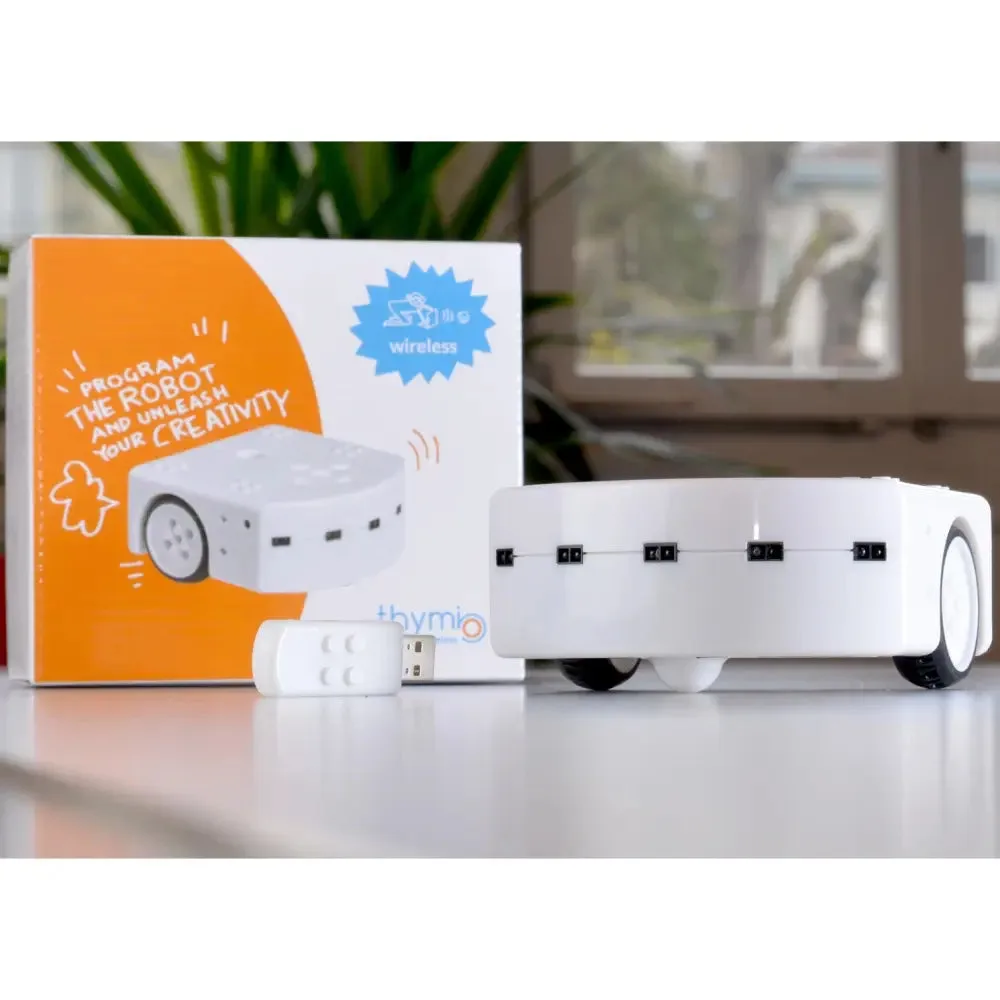
$186 – $240October 2026 check. Thymio Wireless $185.99 and ThymioAI $239.99 on RobotShop US (sold and fulfilled by Thymio, price includes US tariffs); 6-robot suitcases $1,335–$1,616. The older USB-only Thymio II listing on RobotShop has been removed. Thymio II was created at EPFL in 2011, and the wireless version added a 2.4 GHz radio and USB dongle.
AvailablePython from a laptopPalm-sizedOpen hardwareClassroomPython6 built-in behaviors
Possibly ≤ 1 weekShipping: Unconfirmed. RobotShop US lists Thymio Wireless as in stock (37 units in October 2026), but it is sold and fulfilled by Thymio itself, and the price includes US tariffs, which suggests it ships from abroad (unconfirmed). Thymio also lists STEM Crafters (Dallas) and TechyKids (Menlo Park) as US resellers. RobotShop ↗
Remote control: Thymio Suite runs on macOS, Windows and Linux. The tdmclient Python package talks to the robot over USB or the wireless dongle through the Thymio Device Manager, so Python on a laptop can read sensors and set motor speeds live.
Overview
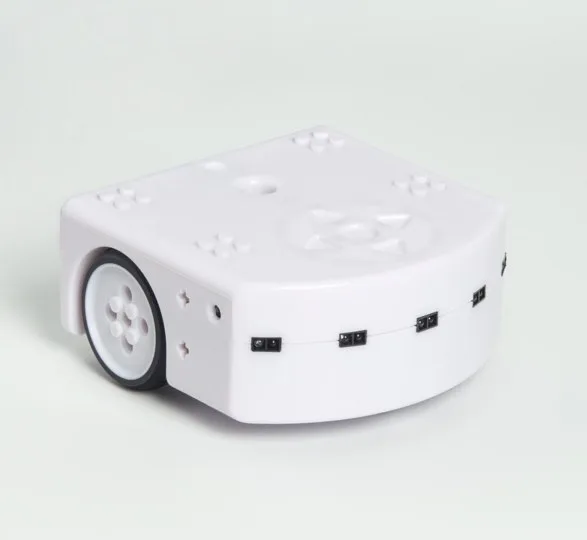
A rugged, ready-built classroom robot from EPFL and ECAL whose mechanics, electronics and software are all open source. It ships with six pre-programmed behaviors (shown by its color), then moves on to visual blocks, Scratch, text and Python, which is why it is used from primary school through university robotics courses. Some 74,000 had been made by 2021, with over half in Swiss and French schools. The catch is dated hardware, with a 16-bit microcontroller, no camera and only IR sensing, and US buyers mostly order through RobotShop's marketplace.
A proven, open classroom robot that suits teachers more than hobbyists looking for computer vision or expansion.
Specifications
| Category | Wheeled rovers · Classroom coding cars |
|---|---|
| Released | 2011 |
| Country | Switzerland |
| Availability | Available |
| Sales | About 74,000 Thymios manufactured in its first ten years (2011–2021, estimate) EPFL ↗ |
| Programmability | Open source (hardware + software) |
| Built-in autonomy | Reactive · Responds to its surroundings without a map, such as avoiding obstacles or following a person |
| LLM support | Possible via SDK · No built-in LLM, but the official tdmclient Python module can read sensors and drive the robot from a computer, so an LLM could be connected with custom code. |
| MuJoCo simulation | None found · Nothing found. |
| NVIDIA Isaac simulation | None found · Nothing found. |
| Gazebo simulation | Community model · Third-party URDF/SDF Thymio model for Gazebo from the ROS2swarm project, exposing odometry, velocity commands, proximity sensors and accelerometer. Webots, Aseba Playground and CoppeliaSim also have Thymio models. ROS2swarm/thymio_description ↗ |
| Best for | Ages 6+ (maker rating) |
| Vision sensors | No vision sensors |
| Actuators | DC / gear motors |
| Audio | Speaker, Microphone |
| Compute type | Arduino / ESP32 / microcontroller |
| Remote control | Python from a laptop |
| Size | 11 × 11.2 × 5.3 cm, 270 g |
| Drive | 2 DC motors (differential drive) with a rear caster |
| Compute | Microchip PIC24FJ128 microcontroller running the Aseba virtual machine |
| Vision | None |
| Lidar | None |
| Sensors | 9 infrared proximity sensors (7 horizontal, 2 ground-facing, about 10 cm reach), 5 capacitive touch buttons, 3-axis accelerometer, thermometer, microphone, IR remote receiver, microSD slot |
| Runtime | Li-Po 3.7 V 1,500 mAh, 3–5 hours (wiki) or "more than 2 hours" (current product page), 1–2 hour USB charge |
| Speed | 14 cm/s max |
| SDK | Thymio Suite with VPL, VPL3, Scratch, Blockly and Aseba text, plus the tdmclient Python module. Hardware under CC BY-SA 3.0, software under LGPL |
Ratings & reviews
Ratings and reviews load on the live site.
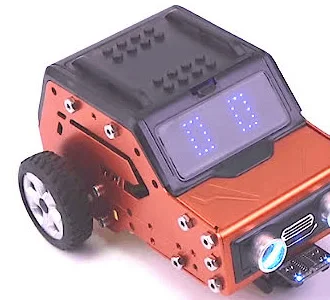 WeeeBot mini
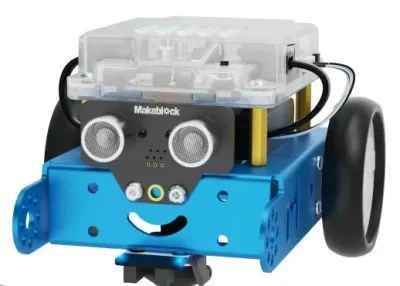 mBot
mBot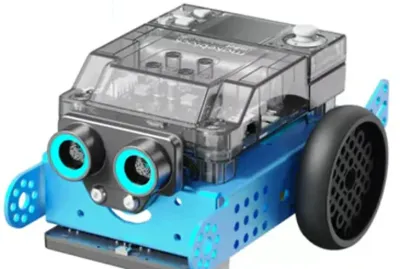 mBot2 / mBot Neo
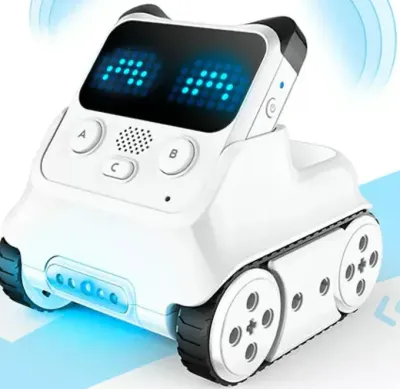 Codey Rocky
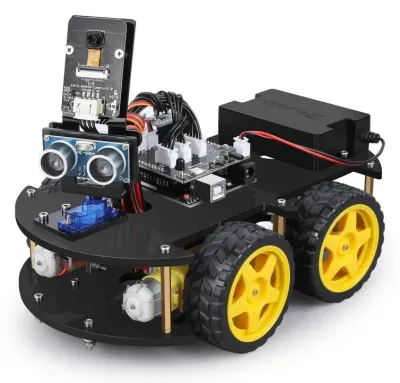 ELEGOO Smart Robot Car Kit V4.0 (with Camera)
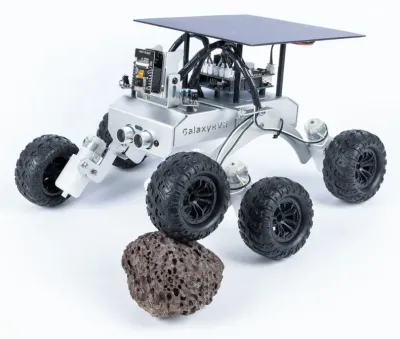 SunFounder GalaxyRVR Mars Rover Kit