This log covers November 17. The whole day went into speed. A new walker went onto the robot, and LocksleyFox ran in the living room, the garage, the driveway and the road out front. It set a few distance records, broke a styrofoam board, and lost a plug outside. By the end of the night it was probably running a little over 2 m/s. The hardest part turned out to be measuring that.
A faster walker
The night before, I had matched the simulator's paw contact to the real robot. The simulated paws had been too springy, so the simulated robot bounced along faster than the real one. With the contact fixed, I trained a few faster walkers. One of them lets the hips swing further. Another learned a slightly bouncier, bound-like rhythm at high speed. In simulation that last one reaches 2.07, 2.43 and 2.65 m/s when asked for 2.0, 2.5 and 3.0. It didn't fall once in the test suite, and its feet land more softly too. That's the walker that went onto the robot.
A stumble on the rug
The first test was a slow 1.0 m/s walk in the living room. One paw caught the edge of a rug about a third of an inch thick. The robot stumbled, then sat down and stopped. The hip had fallen 0.62 rad behind where it was told to be, just over the 0.6 rad limit that means a jammed joint.
A small stumble shouldn't end a walk. So now a joint has to fall behind by 1.0 rad, or stay well behind for a quarter of a second, before the walk stops. Recovered stumbles are just logged. If a joint really does seem stuck, the robot pauses for a second, then tries again. If the same joint keeps getting stuck, it's a real problem, and the motors ease off. On the next runs, a small stumble no longer stopped it.
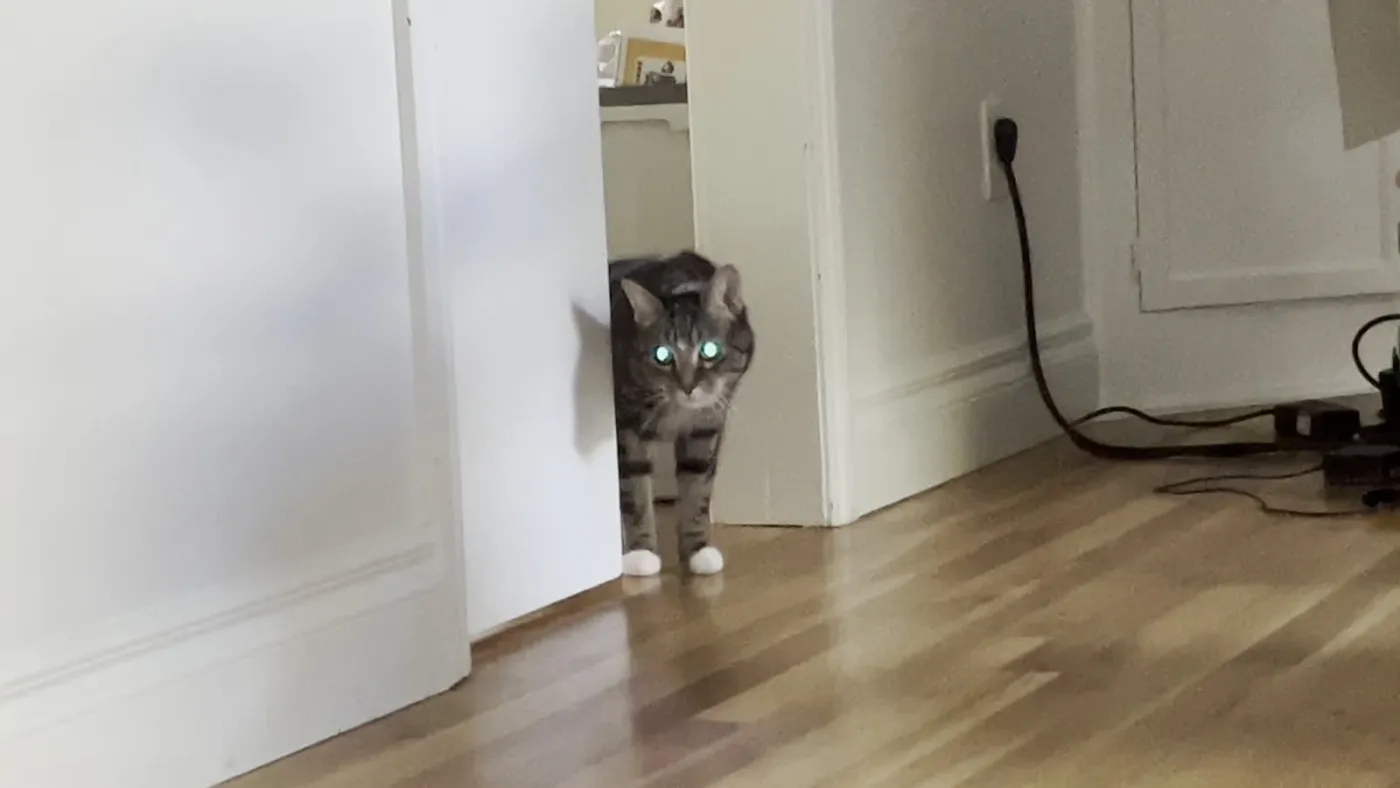
On one of those living room runs, our cat came out from behind a door to see what was coming toward it.
The speed that wasn't there
In the garage I set the speed to 1.5 m/s, and the robot walked about 7 meters to the door. But the speed in its log leveled off at about 1.1 m/s. The robot works out its speed from how far its planted paws move. At a fast trot, all four feet are off the ground for part of each stride. The simulator says that's about 45% of the time at 2.0 m/s. During those moments no paw is planted, so the robot doesn't count any distance at all. The robot wasn't slow. Its speedometer was reading low.
I tried counting the stride only while the lower pair of feet carried weight, using the motor torques. It didn't work on the real robot. The torque readings can't tell when a foot is in the air.
Outside on the driveway
Next I took it outside to our driveway, which is cracked, mossy and covered in leaves, and asked for 2.0 m/s for 8 seconds. It went about 40 feet (12.2 m). That's the farthest it had ever walked in one go, at roughly 1.5 m/s. The bumps slowed it down. In simulation, 20 mm bumps cost up to a third of its speed.
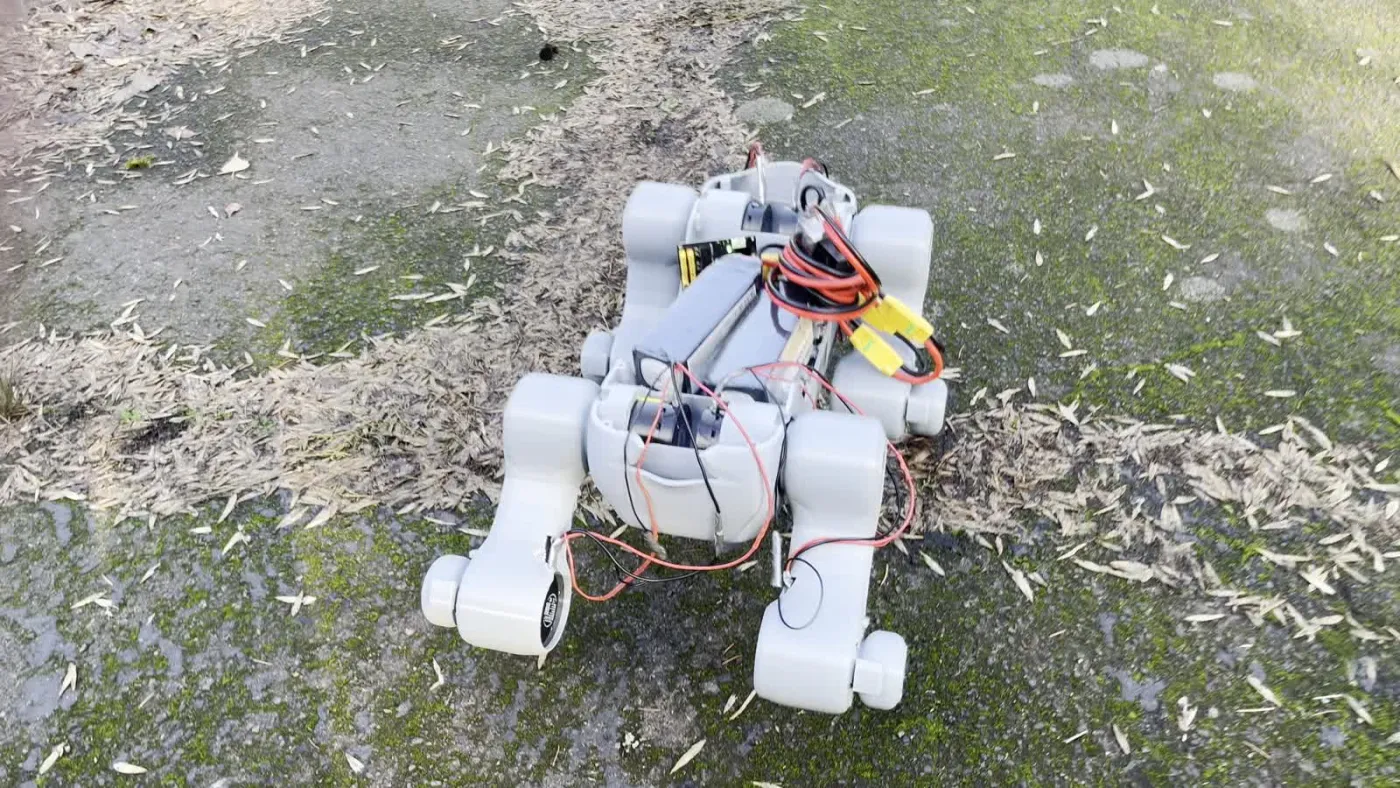
At the end of the last run, the front-left leg folded under it. The plug on the front-left hip motor, the one underneath the body tube, had worked partly loose. That motor went silent for 51 ms, so every motor eased off as a safety step. I pushed the plug back in. The next body needs something that holds those plugs in place, like a clip or a strap.
Since the robot keeps tripping on rough ground, I trained a version of the walker on a bumpy simulated floor, with bumps up to 20 mm. On 15 to 20 mm bumps it's 15 to 47% faster than the current walker, and about the same on flat ground up to 2 m/s. It isn't on the robot yet.
Shorter cables
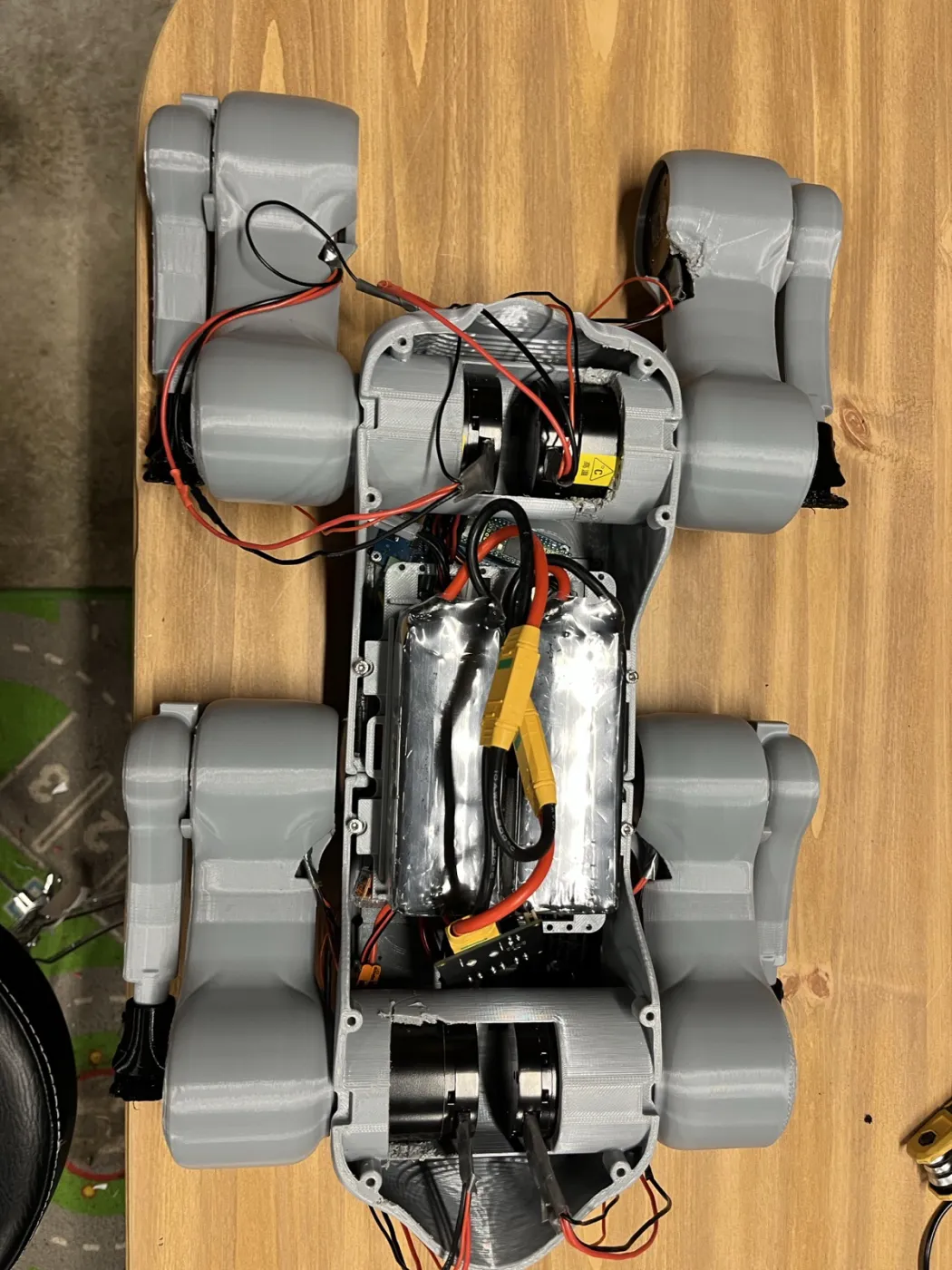
New, shorter motor cables arrived, so I swapped them in and took out the one long lead. The robot now weighs 14.6 lb (6.6 kg), down from 15.2 lb.
Through the styrofoam
Back in the garage that evening I ran it at 2.0 m/s. On one run it went straight into a styrofoam board leaning against the wall at the end, and broke it.
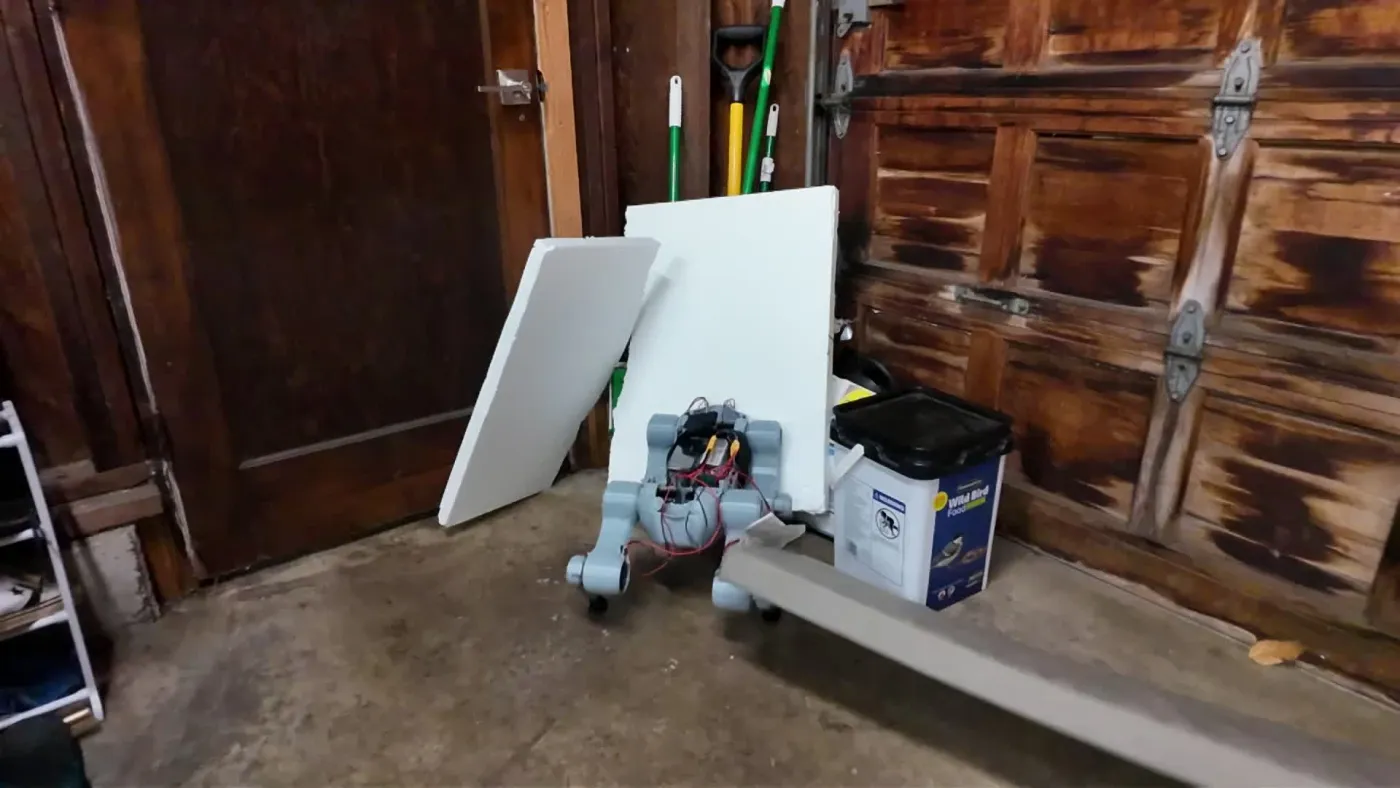
After that I measured runs with a tape. At 2.0 m/s for 3 seconds, it went 215 inches (5.46 m). At 2.5 m/s it went 240 inches (6.10 m). That puts its steady speed at about 1.7 m/s when asked for 2.0, and its peak somewhere around 2 m/s when asked for 2.5.
Once, after a run, all its motors went limp while I carried it back. That wasn't a fault. When it runs without a cable, the robot eases off every motor if it's held face down, and I must have been carrying it tipped nose down.
The control panel picked up two small changes during the day. The robot's picture now shows the total power the motors are using right now, like "42 W". And the auto-stop time for push walks now goes in half seconds, which makes it easier to fit a run into the garage.
Measuring with the IMU
The robot's IMU measures acceleration, so in theory adding up the forward acceleration gives speed, and adding up the speed gives distance. In simulation that came within about 8% of the true distance. The trick is removing gravity. Even a 1° error in which way is down adds 0.17 m/s2 of fake acceleration.
On the real robot it didn't work as well. Over four tape-measured runs it was off by +13%, −4%, −20% and −33%. I logged every raw IMU reading during a walk to find out why. On its own, the IMU thought a 5.5 m run had covered 9 m. The error builds up only while it's trotting. My best guess is that the IMU is read 100 times a second, and that's too slow to catch the sharp jolt of each paw strike. The simulated robot moves too smoothly to show this.
For now the Activities page uses the leg distance with a correction instead. The faster the robot is asked to go, the more the leg distance gets scaled up, to make up for the time all four feet are in the air. I fitted that to nine tape-measured garage runs, and it lands within about 6% of the tape. In two blind tests, where I guessed before the tape went down, it came in 6% and 7% short. On the bumpy driveway it reads 18% high, because the robot covers less ground per stride there.
Out on the road
The last runs of the night were on the road in front of the house, which is smooth. I asked for 3.0 m/s and let it run for 10 seconds, twice. I didn't measure these, but the corrected leg distance says about 24.5 m and 26 m, at a steady 2.3 to 2.4 m/s. If that holds up under a tape measure, those were LocksleyFox's first runs over 2 m/s.