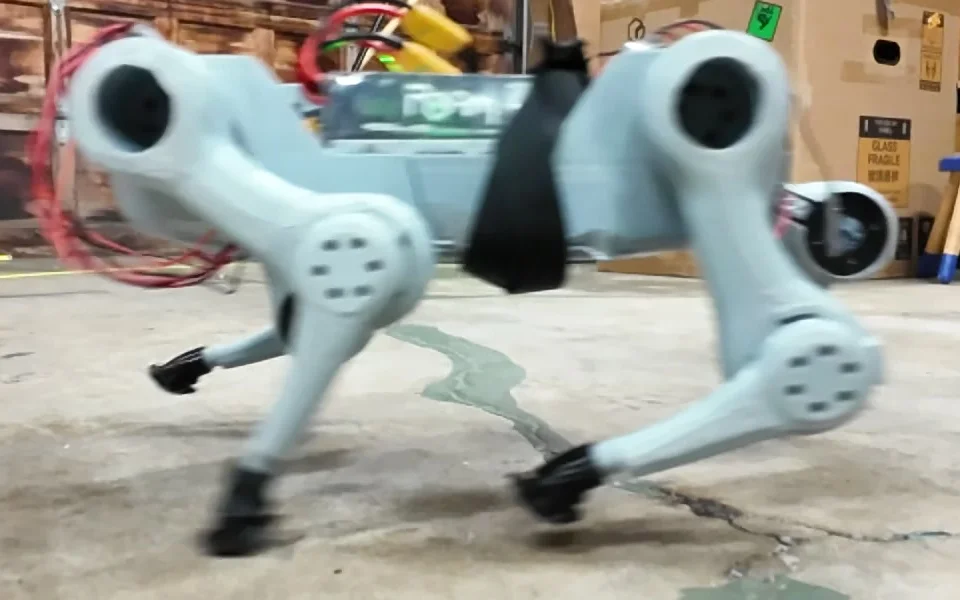
This log covers November 19. A firmware change made it noticeably faster. I also trained a new walker that turned out no faster on the real robot, and then found out from a slow motion video what's still holding it back.
A stop for falls, and more loose screws
After the walker from Log 23 kept kicking while lying on its side, I added a fall stop to the firmware. If the body tilts past 30° during a walk, the walk ends. I also found the six screws that hold the front-right hip motor's output to the thigh were extremely loose. I tightened them.
The first taped runs after that were short. At 2.0 m/s it went 178 inches (4.52 m), well under the usual 210 to 221. That sent me looking for causes again.
The walker was thinking too slowly
The robot logs how long the walker's neural network takes to answer. From reading the sensors to having the answer took 7.7 to 9.3 ms, and about 10 to 11 ms until the motors got the new targets. The walker was trained for 6. The Teensy had been working on the network in small pieces between motor updates, so most of that time was waiting, not computing. The network itself only takes about 2.7 ms.
I changed the firmware to work on it in bigger pieces while still keeping the motor updates on time. Now the answer comes about 3.3 ms after the sensor reading. To check it, I ran 2.0 m/s for 3 seconds twice on the same battery, once with the new timing and once switched back to the old one. With the new timing it went 230 inches (5.84 m) and peaked at 2.10 m/s. With the old timing it went 189 inches (4.80 m) and peaked at 1.65 m/s. That's 22% further from a timing change alone, though the old-timing run was shorter than usual. Against my usual 210 to 221 inches at this speed, the gain is closer to 5 to 10%. At 2.5 m/s it went 217.5 inches (5.52 m). At 3.0 m/s it stumbled partway through one run, so 2.5 is my top setting for now.
I also added torque logging to the walk records. The motors reported only about 70% of the torque the walker was asking for, which looked like the motors were too weak.
A new walker that wasn't faster
With the timing fixed, the simulator was still a bit optimistic. I fit it against all 24 logged runs. No single setting fit best. Several combinations of hip springiness, motor strength and motor lag matched the logs about equally well. So instead of picking one, I trained new walkers across all seven of them. In simulation the best one, s20fast, was 8 to 9% faster than the old walker, with no falls and about the same torque.
On the real robot it tied. At 2.0 m/s it went 226 inches against the old walker's 230, and at 2.5 m/s 210 against 217.5. It walked fine, unlike the springy-leg walker from Log 23, but the speed gain didn't show up.
The motors are fine
To check the motors on their own, I put the robot on its stand with all four legs in the air and ran the walker at 2.0 and 2.5 m/s. With only the legs' own weight as the load, I replayed the same joint targets in the simulator. The simulated legs moved within 1° of the real ones, using full-strength motors. Weaker or slower simulated motors matched worse. So the motors deliver what the simulator says they do. It's the motor's torque reading that comes out low, about 58% of the real torque at the hips and 30% at the knees.
Scraping paws
Last, I filmed three runs at 2.5 m/s in 240 fps slow motion, with the camera on the floor at the side. At first I only checked whether the planted paws slipped, and they didn't. Looking frame by frame, I noticed something else. After each push-off, the paw stays on the floor and slides forward. The rear-left paw slid about 12 cm along the floor for about 75 ms before it lifted. In the simulator, every paw is more than 1 cm up within 15 ms.
The joint angles say the legs do lift the paws as planned. So the legs must be getting shorter under load, from the shank bending, the TPU paw squashing and the hip mounts giving. A leg carrying weight sits a few millimeters lower, and the unloaded swinging leg then reaches the floor partway through its swing. When I gave each simulated paw a spring so the legs shorten a little under load, the simulated paws scraped the same way. With about 3 to 4 mm of squash under 100 N, the old and new walkers came out equally fast, just like on the real robot. I started training walkers on these springy legs, and on a bumpy floor, so they learn to lift their paws higher.