This log covers November 20. A new walker went onto the robot and set a distance and speed record on the road. The rear-up bounce trick ran on the real robot for the first time, with mixed results. The printer kept working through the carbon-fiber body parts for the next version.
A walker trained on springy legs
Log 24 ended with paws scraping the floor because the legs shorten under load. So I trained several new walkers in a simulator where each leg gives a few millimeters under weight. Some also trained on a floor with small bumps. The best all-rounder, s22rl3, trained on springy legs and 3 mm bumps. It went onto the robot as fox_panel 76.
This time the gain held up on the real robot. At 2.0 m/s for 3 seconds it went 235 inches (5.97 m), against 226 for the walker from Log 24. At 2.5 m/s for 2.5 seconds it went 232 inches (5.89 m), against 210. That's about 10% further at 2.5 m/s.
A new record on the road
Outside on the road, I asked for 3.0 m/s. On one run it went 27.2 m, peaking at 2.86 m/s (6.4 mph) and cruising at about 2.4 to 2.6 m/s. Those are both records. The road there slopes down 2 to 3°, so gravity helped a little. A second run on level road went 21.3 m with a 2.26 m/s peak.
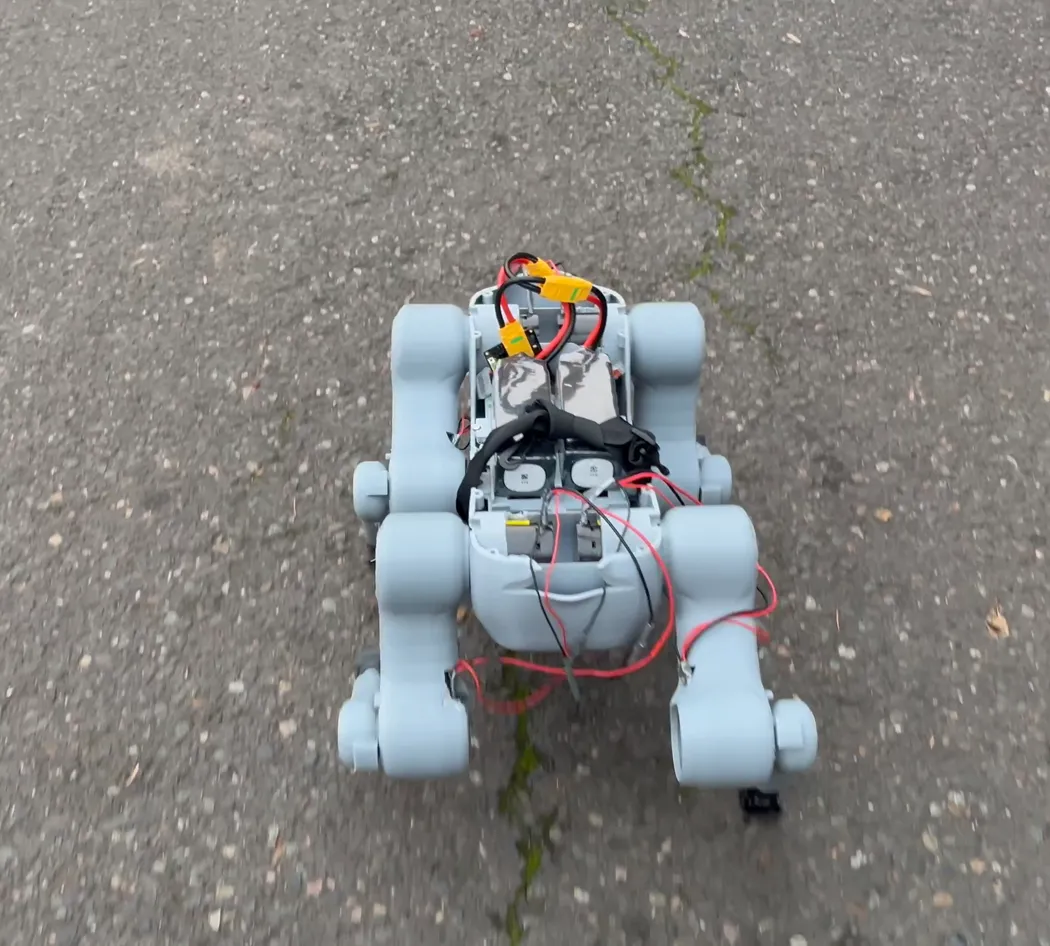
One slow run ended badly. At 1.25 m/s it turned 40° to the left, the front-left hip fell well behind for a long stumble, and the body tilted past 30°. The fall stop from Log 24 eased the motors off as designed. I haven't found out why it veered.
Faster in the simulator only
While waiting to test, I trained a sprint-only walker. In simulation it reaches 2.82 m/s when asked for 3.5 and peaks at 3.1. It also needs about 15 m of room, 5 of them just to stop. I also tried the longer 1.5x shanks with these walkers. Their top speed came out at 3.05 m/s against 2.97 for the regular legs, with no gain at all at 2.0 to 2.5 m/s. Neither one went onto the robot.
Small safety fixes
During one test the front-right knee motor was off the bus, and the robot stood up anyway on the other seven joints. Stand now refuses unless all eight leg joints answer. I also fixed a problem with the push triggers. After a walk started by a push, a push from the front did nothing. The robot had stood back up with less weight on its paws than at the first stand, so the triggers thought a hand was still on it. Now every new stand learns its resting weight again.
Still scraping
A 240 fps video showed the paws still scraping forward about 12 cm after push-off. One cause turned out to be in how the motors are told to move. Each motor pushes toward its target like a spring, with damping that resists any movement. That damping also brakes the moves the walker plans, so a leg trails its target by about 20 ms, both on the robot and in the simulator. I changed the damping to resist only the difference from the planned speed. A test walker with a higher rear-left paw lift went 226 inches at 2.0 m/s, 4 to 6% short of s22rl3, so I went back to s22rl3.
On that walk the USB cable got tugged as the robot ran past the camera. The Teensy dropped into its bootloader, the motors stopped getting commands, and the front-right leg folded. He was fine after a restart.
I also put in a new battery door. It's much more solid and a little lighter. The next 2.0 m/s run went 240 inches (6.10 m).
The first bounce
The tricks from the simulator now ride along with every walker build. In the evening I tried the rear-up bounce on the real robot for the first time. Each try turned up a new problem. First the front paws snapped forward before the bounce. The trick's starting pose was 5 to 6° off from the real standing pose on every joint. After fixing that, a joint speed limit stopped the snap but also stopped the bounce. He only twitched twice and rose 6°. With a looser limit he bounced a little, then got stuck vibrating. After a small bounce he settled a few degrees nose up, and the trick never saw him back at level to finish. By the end of the night he still snapped forward at the start, and the bounce was shallow.
Carbon-fiber parts
The printer is working through PAHT-CF, a carbon-fiber nylon, for the next body. The rear tub finished and came out with strings inside, stacked on every layer. The print head traveled straight across the open middle of the tub on each upper layer, and at 290 °C every crossing left a string. PLA did the same thing, just less. The sideways screw holes also came out slightly oval, with flat tops where they bridge.
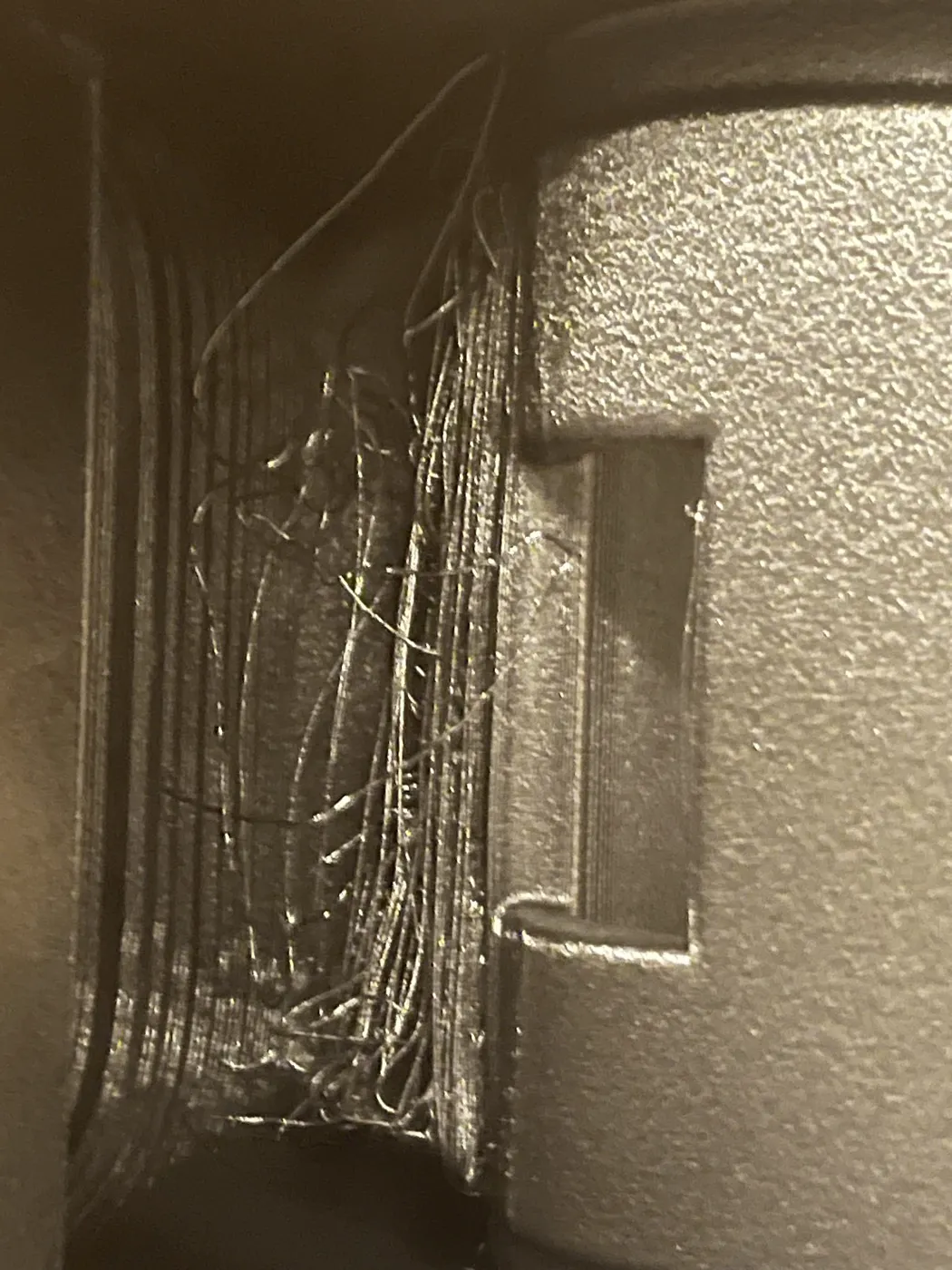
For the front tub I changed the slicer to keep travel moves along the walls, gave the screw holes a teardrop point at the top, and made the motor bore 0.2 mm smaller for a snugger fit. It started printing that night, about 14 hours. A left thigh also printed, and a motor went in without trouble. The battery deck printed the day before came out a little bent, probably from taking it off the plate while still warm.
I also edited two videos, one on the speed record and one on how the tricks were trained in simulation.