In simulation, the thing that limits speed and payload has always been heat in the knee motor, an RS00. The simulation's heat model starts from RobStride's tables for a motor bolted to a metal heat sink. For a knee motor inside the robot, the simulation assumes it sheds heat less well, but that part is only an estimate. Nobody seems to publish real thermal data for these motors, so the only way to check that guess was to heat one up.
The setup reuses the stand from the torque test. This time a steel extension spring hooks onto the lever's 200 mm hole, and a cord holds its far end. The motor pulls against the spring with a steady torque plus a small wobble twice a second, a bit like a knee holding the robot up while it walks. The Mac logs the motor's own temperature sensor, and the test stops itself at 100 °C.
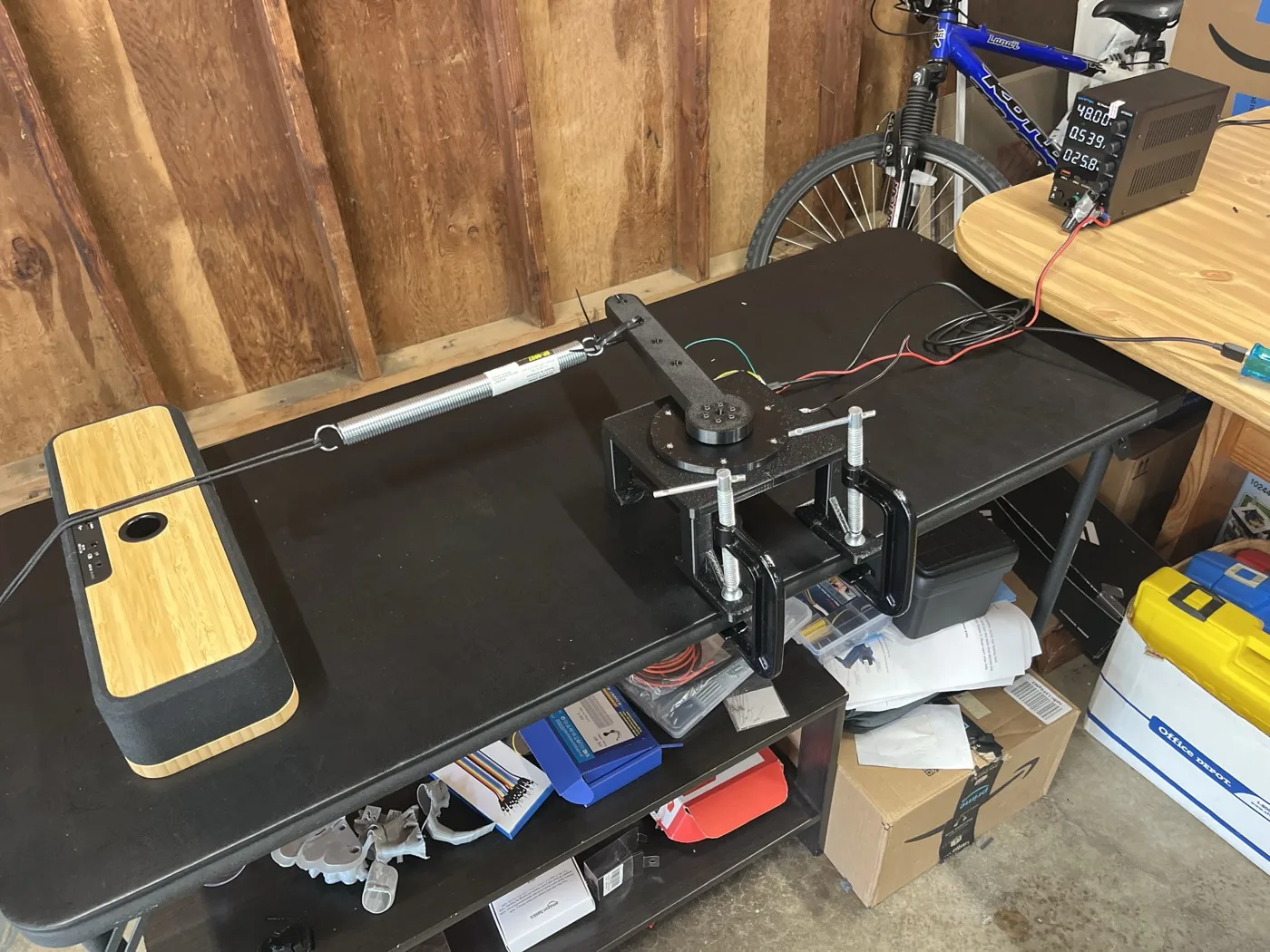
The first direction check moved the lever only half as far as expected. A photo of the rig showed why. The towel I'd put down as a soft stop was on the wrong side of the lever and was holding it back. With the towel moved, the lever swung the expected 3°.
The main run asked for 4.2 N·m, about 85% of the motor's rated torque. The motor went from 17 °C to 100 °C in just over nine minutes, and it was still climbing when the cutoff stopped it. The power supply showed something interesting along the way. It drew about 22 W at the start and 28 W near the end for the same torque. Copper's resistance rises as it heats up, so the hotter the windings get, the more power turns into heat.
After the run the printed stand around the motor was still cool to the touch, and only the lever's hub was a little warm. Most of the heat leaves through the motor's own case into the air. Fitting the heating and cooling curves gives the motor's thermal resistance, how many degrees it rises above the room for each watt of heat. It came out at roughly 4 to 5 °C per watt. That's close to RobStride's own heat-sink setup. But this was the bare motor in open air. Inside the robot the knee motor sits in a mostly closed printed housing with a few vents, which will trap heat. I haven't tested that yet. The simulation's figure for the housing comes from a calculation, and it lands at roughly 5.5 to 9 °C per watt, depending on the vents and airflow. Testing the motor inside a printed thigh is the next step after this one.
One run isn't enough to trust that number. The motor never levelled off, so the fit had to guess where it would have settled. The next run uses a lower torque, 3 N·m for 45 minutes, which should give the temperature time to settle on its own.