Log 5 left two questions open. The first run never levelled off, so its number was partly a guess. And it tested the bare motor in open air, while in the robot the knee motor sits inside the thigh, wrapped by a printed wall.
The same evening I ran the longer test, at 2.4 N·m for an hour. I dropped the torque from the planned 3 N·m so it would match the housing test. Starting from 14 °C, the motor climbed for 45 minutes and peaked at 89 °C. My model had predicted around 40 °C. Near the end I opened the garage door a few times, and the draught pulled it back down to 81 °C.
Why so much hotter? The model only counted the heat from current flowing through the copper windings. So I held a few torques for a couple of minutes each and read the watts on the power supply. Holding still, the motor does no mechanical work, so every watt it draws ends up as heat inside it. At 2.4 N·m it drew 9.3 W, about twice what the copper alone explains. Even holding almost nothing it used about 3 W. Some of that is the motor's built-in driver electronics. Counting the real watts, the bare motor on the stand rises about 7.5 °C per watt, more than the 4 to 5 from Log 5.
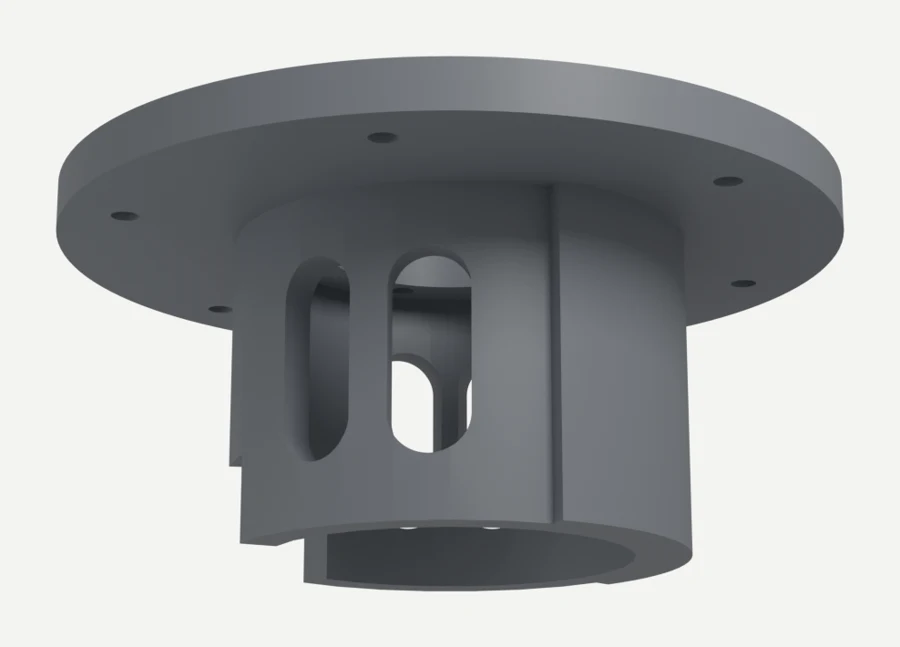
For the housing test I printed a new version of the stand's adapter in PETG with the knee wall from leg 1.0e. It has a 6 mm wall, a 1.5 mm air gap around the motor and four vent windows. Everything else stayed the same: the lever, the spring and the cord.
The bare motor already reached about 90 °C at 2.4 N·m, so this run used 1.5 N·m. I also added a 75 °C cutoff, because PETG starts to soften not far above that. From 14 °C the motor rose to 41 °C and levelled off after 47 minutes. The supply read a steady 4.5 W the whole time. Afterwards the motor case was a little warm, the plate and lever hub less so, and there was no smell and no warping.
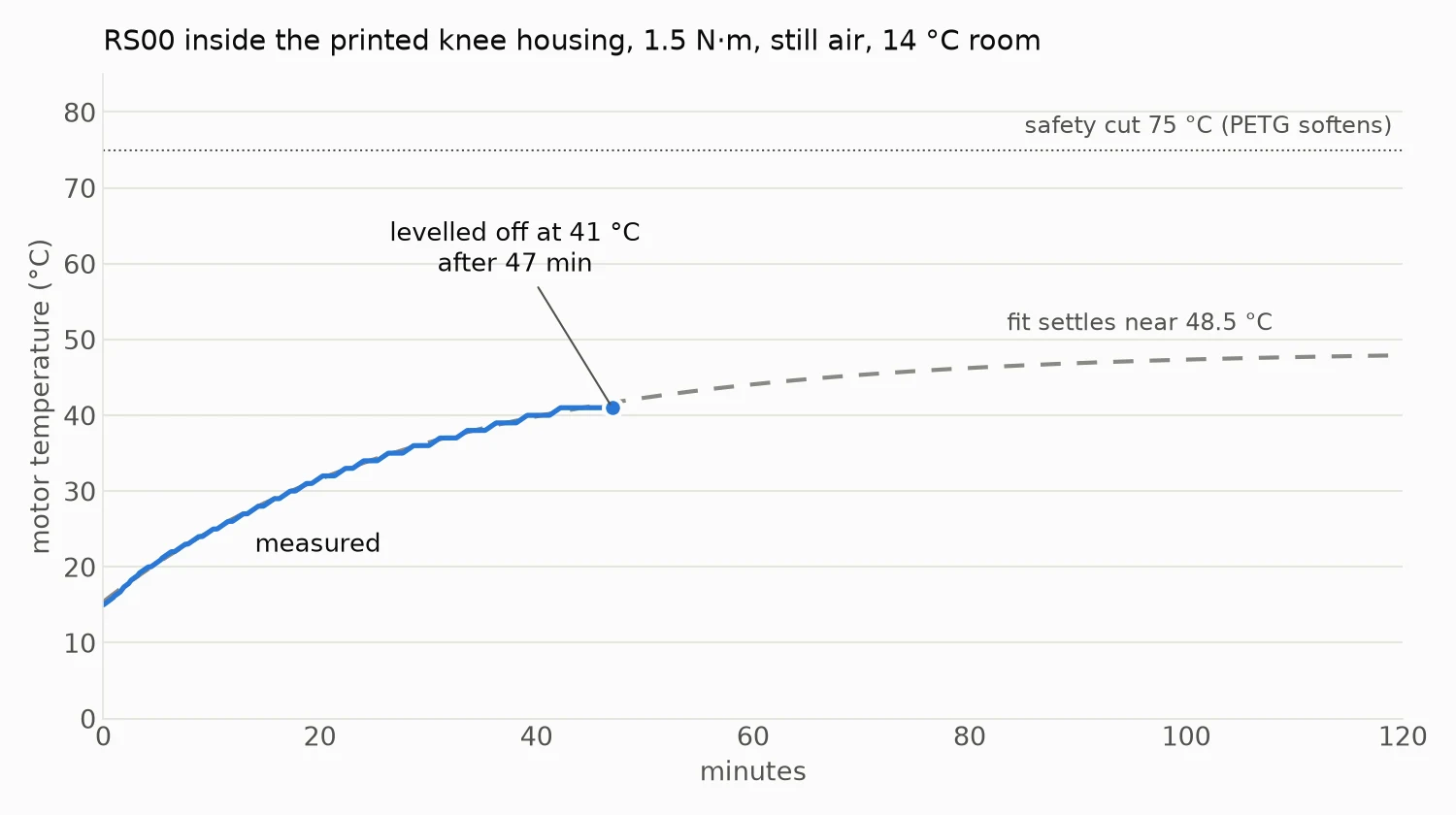
That works out to about 7.7 °C per watt, against 7.5 for the bare motor. Fitting all three runs together puts the housing somewhere between no worse and 20% worse. The plastic isn't acting as a heat sink, since PETG barely conducts heat. The vents and the air gap simply let the heat out about as well as open air does.
Then I put the measured numbers into the simulation's heat model. They pull in two directions. Over a long time the motor runs hotter than the old guess, but the motor and the plastic around it soak up more heat first, so it takes longer to get there. In still air, the knee can hold about 2.6 N·m forever before the windings reach their 145 °C limit. Walking in the simulation needs more than that at the knee, so no walking speed can go on forever. The table shows how long each leg design walks from a cold start before the knee needs a rest.
| Leg and speed | Knee load | Old estimate | Measured housing |
|---|---|---|---|
| 1.0c, 0.5 m/s | 4.0 N·m | 9 min | 20 min |
| 1.0c, 1.0 m/s | 4.2 N·m | 6 min | 17 min |
| 1.0c, 1.5 m/s | 4.8 N·m | 4 min | 12 min |
| 1.0d (soft ankle), 0.5 m/s | 3.3 N·m | no limit (levels off at 122 °C) | 36 min |
| 1.0d (soft ankle), 1.0 m/s | 3.7 N·m | 12 min | 24 min |
| 1.0d (soft ankle), 1.5 m/s | 4.4 N·m | 5 min | 15 min |
Times are from a cold start in still air at 25 °C, until the windings reach 145 °C. The current design, 1.0e, is 1.0d with lighter parts, so it should do about as well as the 1.0d rows or slightly better.
All of this is still air. A walking robot moves air over its legs, which can only help. The next run is the same test with a fan blowing on the motor.