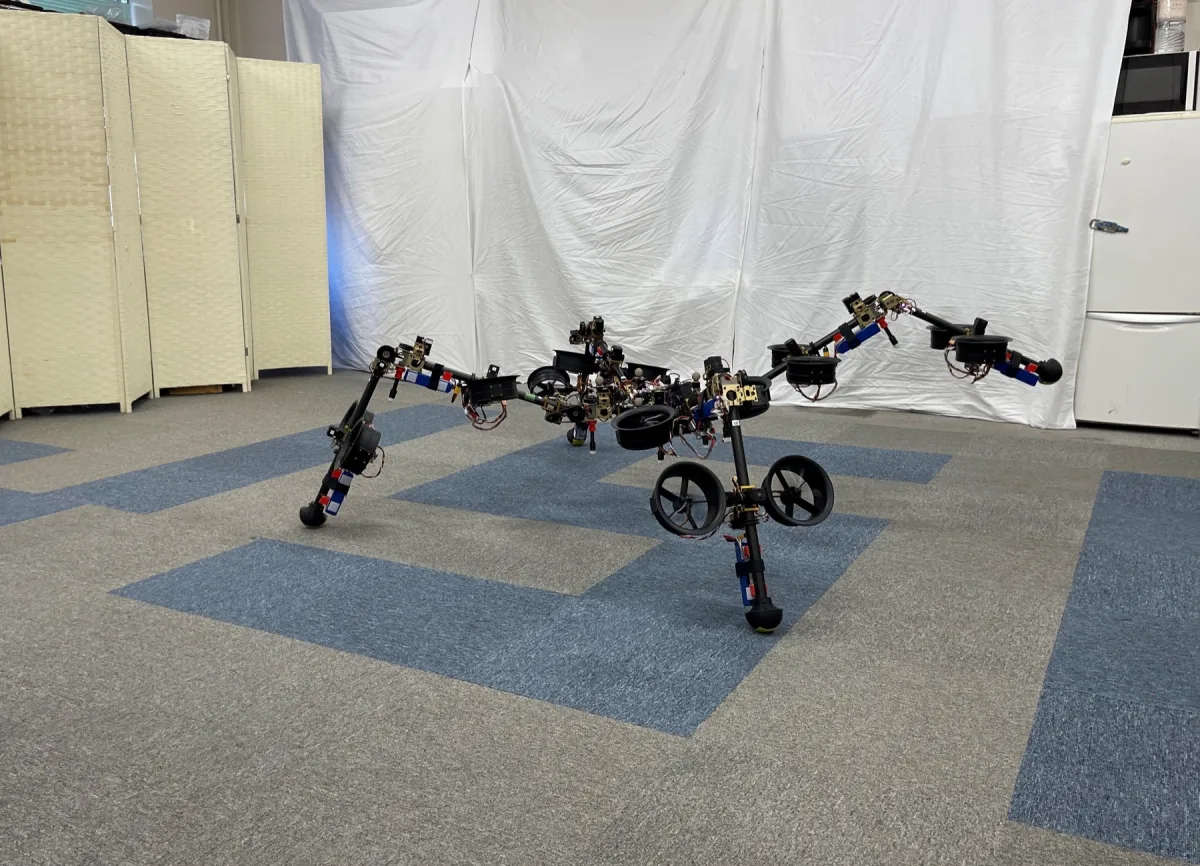
Not for saleUniversity research prototype, first described in a 2023 IEEE Robotics and Automation Letters paper.
Not for sale (research)Not programmableWalks and flies16 tilting rotorsQuadruped
Not for saleShipping: Not for sale. A research prototype that was never sold.
Remote control: Not possible. Research prototype.
Overview
SPIDAR is a four-legged robot from the University of Tokyo whose eight leg links each carry a pair of ducted rotors that can tilt in any direction. The same thrust helps the leg joints hold up the 15 kg body during walking and lifts the whole robot in flight, so it has no separate body rotors. In the 2023 paper it walked for five gait cycles and then took off straight from its standing pose. Later work added a crawling gait where all four legs lift at once. Like LEONARDO, it uses thrust to help its legs. It remains a lab prototype.
Specifications
| Category | Drones · Fly + drive or walk |
|---|---|
| Released | 2023 |
| Country | Japan |
| Availability | Not for sale (research) |
| Programmability | No programmability |
| Built-in autonomy | None / scripted · Moves only when controlled, or plays preset motions |
| LLM support | None · No built-in LLM and no SDK to connect one. |
| Best for | Professionals & labs |
| Vision sensors | No vision sensors |
| Actuators | Mixed |
| Audio | No audio |
| Compute type | NVIDIA Jetson, Arduino / ESP32 / microcontroller |
| Remote control | Not programmable |
| Size | 15.2 kg. Spans up to 2.7 m with legs spread, each of the eight leg links is 0.54 m long. |
| Drive | Four legs with two links each. Every link carries a ducted pair of counter-rotating 5-inch brushless rotors (16 rotors in all) on a two-axis vectoring mount turned by Dynamixel XL430 servos. Leg joints use Dynamixel XH430 servos with pulleys. Rotor thrust helps the joints carry the body while walking and lifts the whole robot in flight. |
| Compute | NVIDIA Jetson TX2, plus the lab's own Spinal flight-control board and Neuron relay boards on each link, linked over CAN. |
| Vision | None mentioned in the paper |
| Lidar | None |
| Sensors | Joint encoders in the servos. In the published tests, body position and attitude came from an external motion-capture system. |
| Runtime | About 9 min of flight and 20 min of walking on eight 6S 3 Ah LiPo batteries spread across the links. |
| Speed | Not published |
| SDK | None public |
Ratings & reviews
Ratings and reviews load on the live site.
Similar robots
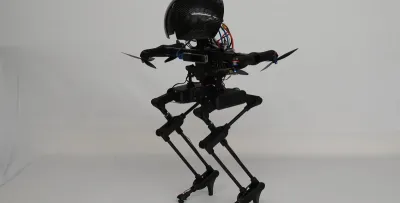 LEONARDO (LEO)Autonomous Robotics and Control Lab (Soon-Jo Chung), Caltech (USA)Not for sale
 RAVENLaboratory of Intelligent Systems (LIS), EPFL (Switzerland)Not for sale
 Husky CarbonSiliconSynapse Lab (Alireza Ramezani), Northeastern University (USA)Not for sale
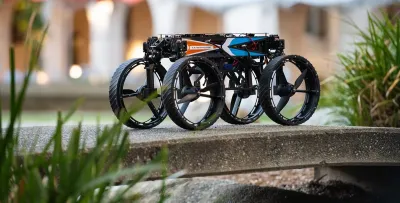 M4 (Multi-Modal Mobility Morphobot)Caltech CAST and Northeastern University (USA)Not for sale
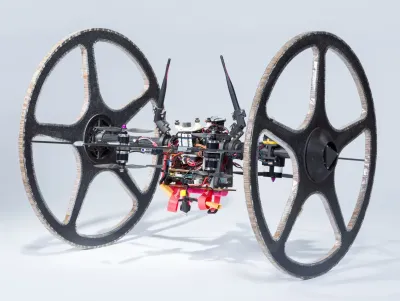 RollocopterTeam CoSTAR, NASA Jet Propulsion Laboratory (USA)Not for sale
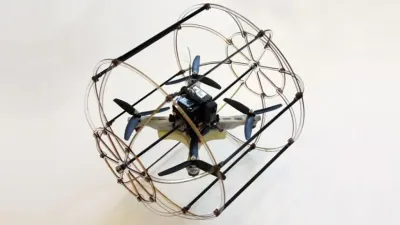 HyTAQRobotics Lab, Illinois Institute of Technology (USA)Not for sale
Image credits
- Image 1: source (DRAGON Lab, University of Tokyo, lab website photo)