Overview
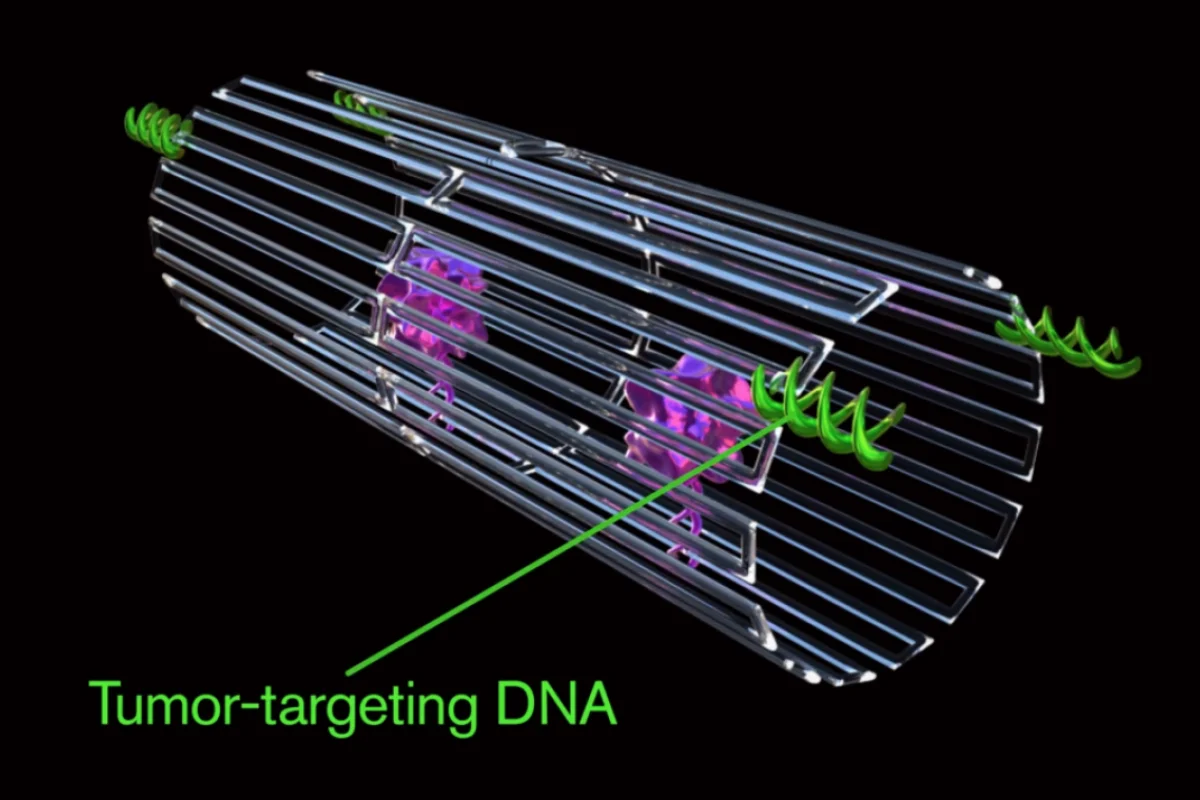
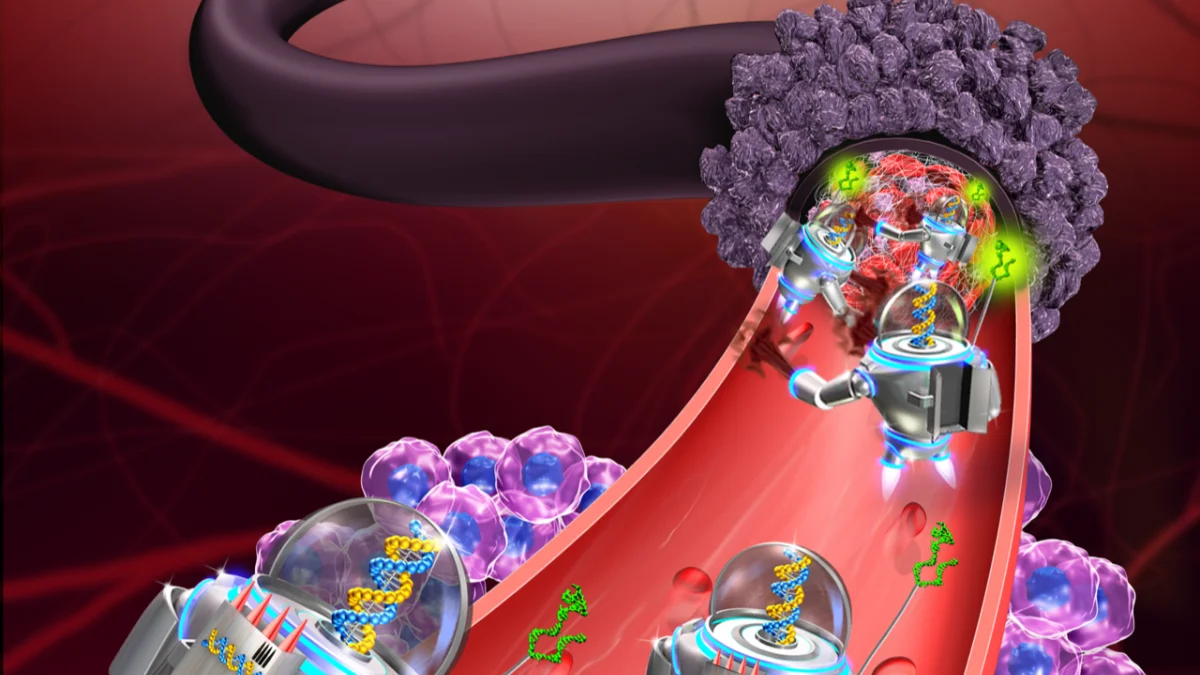
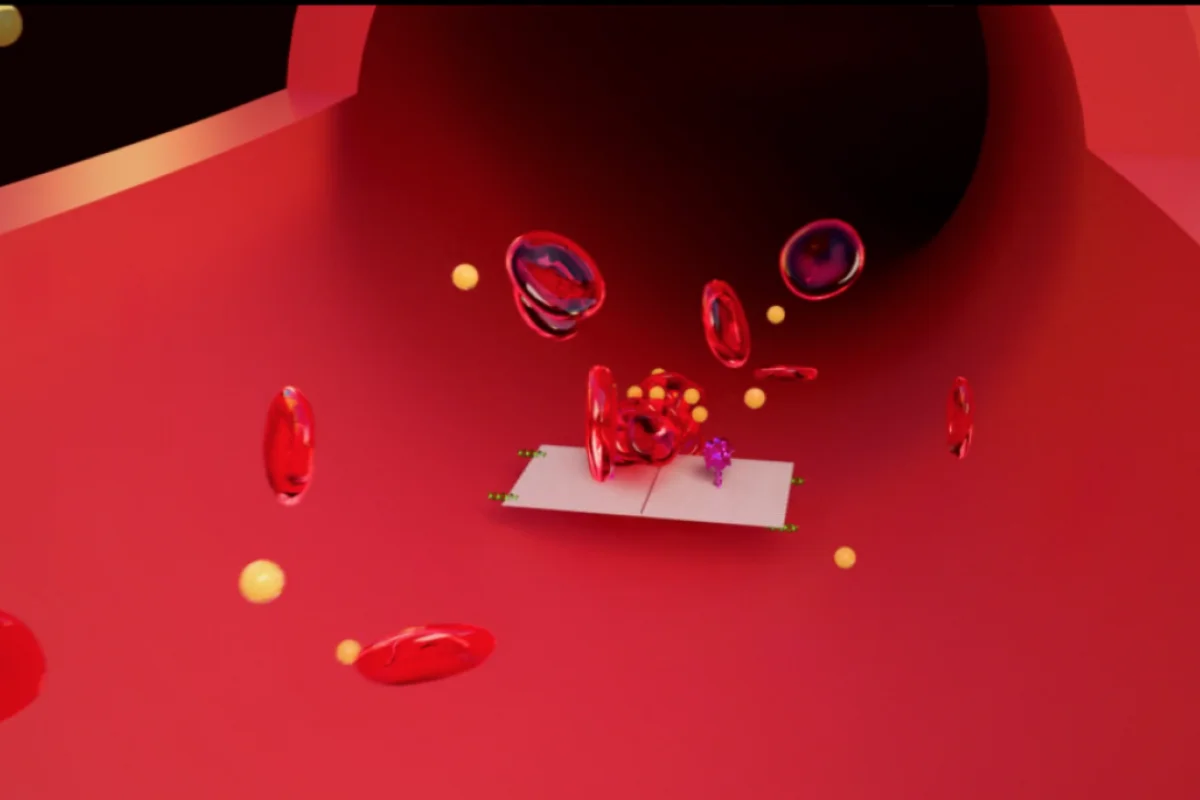
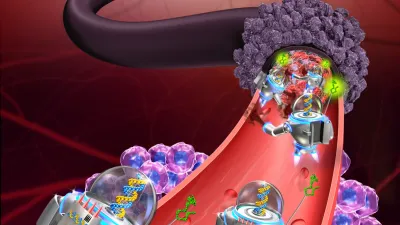
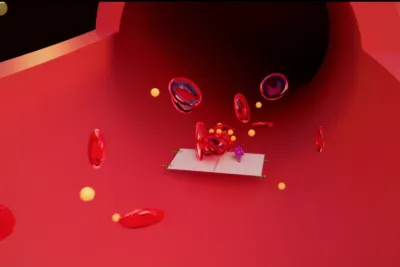
A cancer-fighting robot built entirely from DNA. It uses DNA origami, a method that folds one long DNA strand into a set shape with short "staple" strands. A flat 90 × 60 nm sheet carries an average of four molecules of thrombin, a blood-clotting enzyme. The sheet rolls into a tube about 19 nm wide, hiding the thrombin inside. The tube is held shut by aptamers, short DNA strands that grip one target molecule. Here the target is nucleolin, found on tumor blood vessel walls. When the aptamer locks meet nucleolin, the tube opens and exposes the thrombin. Clots then block the tumor's blood supply. Its "program" is this fixed lock logic, so it has no programmability in the computer sense. Earlier, Shawn Douglas, Ido Bachelet and George Church at Harvard's Wyss Institute built a DNA origami barrel with aptamer locks that acted as a logic gate (Science, 2012).
The ASU and NCNST team reported results in Nature Biotechnology in February 2018. Within 24 hours of injection, tumor blood vessels in mice were blocked. Advanced clotting followed by 48 hours, and dense clots filled all tumor vessels by 72 hours. In a melanoma model, 3 of 8 treated mice had complete tumor regression, and median survival rose from 20.5 to 45 days. Breast, ovarian and lung tumor models also responded, and the robot prevented metastasis. It showed no clotting changes or spread to the brain in normal mice and Bama miniature pigs. The team said in 2018 it was seeking clinical partners. As of 2026, no human trial of this nanorobot has been reported (unconfirmed). The same NCNST group later built a DNA tube vaccine with acid-triggered locks (Nature Materials, 2021). All results so far are in animals.
- Type
- Microrobot · Microscopic robots
- Maker
- Arizona State University (Hao Yan) / National Center for Nanoscience and Technology, Chinese Academy of Sciences (Baoquan Ding, Guangjun Nie, Yuliang Zhao)
- Released
- 2018
- Price
- Not for sale
- Status
- Not for sale (research)
- Best for
- Professionals & labs
- Programming
- No programmability
Price and shipping
Academic research project. No production cost published.
Shipping: Not for sale. Not available. A university research project tested only in animals.
Specifications
| Category | Microrobots & nanorobots · Microscopic robots |
|---|---|
| Released | 2018 |
| Country | USA, China |
| Availability | Not for sale (research) |
| Programmability | No programmability |
| Built-in autonomy | Reactive · Responds to its surroundings without a map, such as avoiding obstacles or following a person |
| LLM support | None · No built-in LLM and no SDK to connect one. It is a folded DNA molecule with no electronics. |
| Best for | Professionals & labs |
| Vision sensors | No vision sensors |
| Actuators | Other |
| Audio | No audio |
| Compute type | No on-board computer |
| Remote control | Not programmable |
| Size | A 90 × 60 nm DNA sheet (2 nm thick) rolled into a tube about 19 nm wide and 90 nm long, roughly a thousandth the width of a human hair (estimate) |
| Locomotion | No propulsion. Injected into a vein and carried by the bloodstream to tumor blood vessels |
| Compute | None. Its only logic is the aptamer lock, which opens the tube on contact with nucleolin |
| Camera | None |
| Sensors | DNA aptamer "fasteners" that bind nucleolin, a protein on the inner wall of tumor blood vessels |
| Runtime | Gathers at tumors within hours of injection. Most nanorobots are cleared or broken down after 24 hours |
| Speed | No self-propulsion, moves with blood flow |
| SDK | None. Behavior is set by the DNA sequences chosen at design time |
Common questions
How much does DNA origami nanorobot cost?
Not for sale. Academic research project. No production cost published.
Can DNA origami nanorobot be bought today?
No. It was never sold to the public.
Who makes DNA origami nanorobot?
DNA origami nanorobot is made by Arizona State University (Hao Yan) / National Center for Nanoscience and Technology, Chinese Academy of Sciences (Baoquan Ding, Guangjun Nie, Yuliang Zhao). It came out in 2018.
Can DNA origami nanorobot be programmed?
No programmability. None. Behavior is set by the DNA sequences chosen at design time.
Does DNA origami nanorobot have AI chat or LLM support?
None. No built-in LLM and no SDK to connect one. It is a folded DNA molecule with no electronics.
Ratings & reviews
Ratings and reviews load on the live site.
Similar robots
 ETH Zurich magnetic microrobot
 Penn/Michigan programmable microrobot
Sources
Nature Biotechnology paper (2018) ↗ · Douglas et al., Science (2012) ↗ · DNA nanodevice vaccine, Nature Materials (2021) ↗ · GEN article ↗