Overview
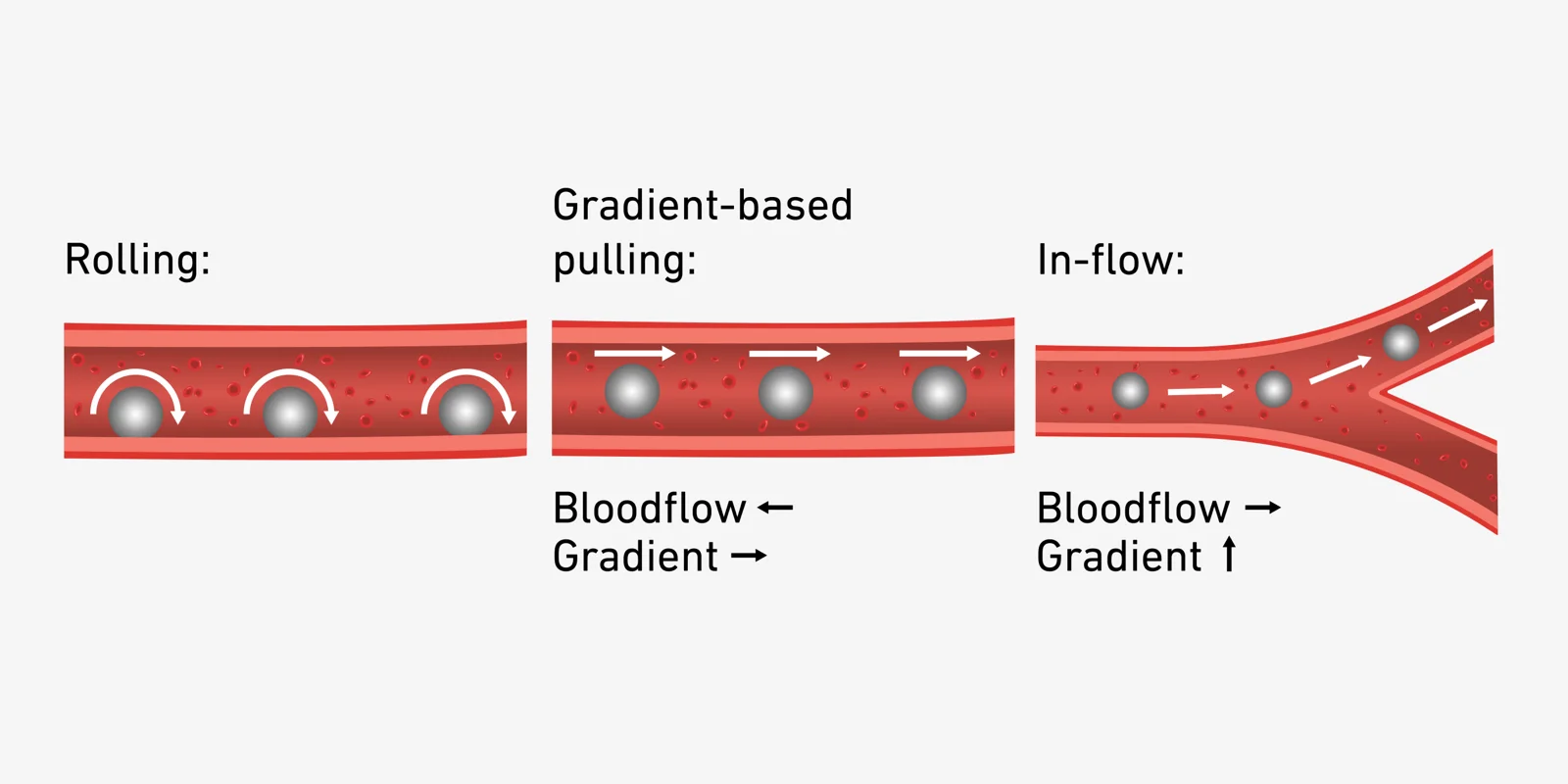
A drug-carrying capsule built to reach blood clots in the brain, with stroke as the first target. The sphere is a soluble gelatin gel holding zinc-doped iron oxide nanoparticles for magnetic steering and tantalum nanoparticles for X-ray visibility. A custom catheter, built on a commercial 7 Fr model, carries it into an artery or the spinal fluid. A small polymer gripper opens to release it. Two electromagnetic units around the head then steer it three ways. It can roll along the vessel wall, get pulled against the flow, or ride the flow while a gradient pushes it into the chosen branch, called in-flow navigation. At the target, a high-frequency field heats the nanoparticles, a process called magnetic hyperthermia, and the gel melts to release the drug.
The Science paper (Landers et al., November 2025) loaded the capsules with a clot-dissolving enzyme (rtPA), an antibiotic (ciprofloxacin) and a cancer drug (doxorubicin). In-flow steering hit the right branch in over 95% of tests, at flows up to 84 cm/s. In a silicone model of a patient's brain arteries, an rtPA capsule began dissolving a human blood clot within 7.5 minutes. In pigs the capsules stayed visible on X-ray as they were steered through the head arteries. In sheep they were guided through spinal fluid into a brain cavity. The vessel models are now sold by ETH spin-off Swiss Vascular. No human trials had started as of the November 2025 coverage, and no 2026 trial news was found.
- Type
- Microrobot · Microscopic robots
- Maker
- ETH Zurich Multi-Scale Robotics Lab (Bradley Nelson, Salvador Pané) (Switzerland)
- Released
- 2025
- Price
- Not for sale
- Status
- Not for sale (research)
- Best for
- Professionals & labs
- Programming
- No programmability
Price and shipping
Academic research platform. The team aims for human clinical trials next.
Shipping: Not for sale. Not available. A university research project.
Specifications
| Category | Microrobots & nanorobots · Microscopic robots |
|---|---|
| Released | 2025 |
| Country | Switzerland |
| Availability | Not for sale (research) |
| Programmability | No programmability |
| Built-in autonomy | None / scripted · Moves only when controlled, or plays preset motions |
| LLM support | None · No built-in LLM and no SDK. Operators steer it with the lab's electromagnetic navigation system. |
| Best for | Professionals & labs |
| Vision sensors | No vision sensors |
| Actuators | Other |
| Audio | No audio |
| Compute type | Laptop / PC as the brain |
| Remote control | Not programmable |
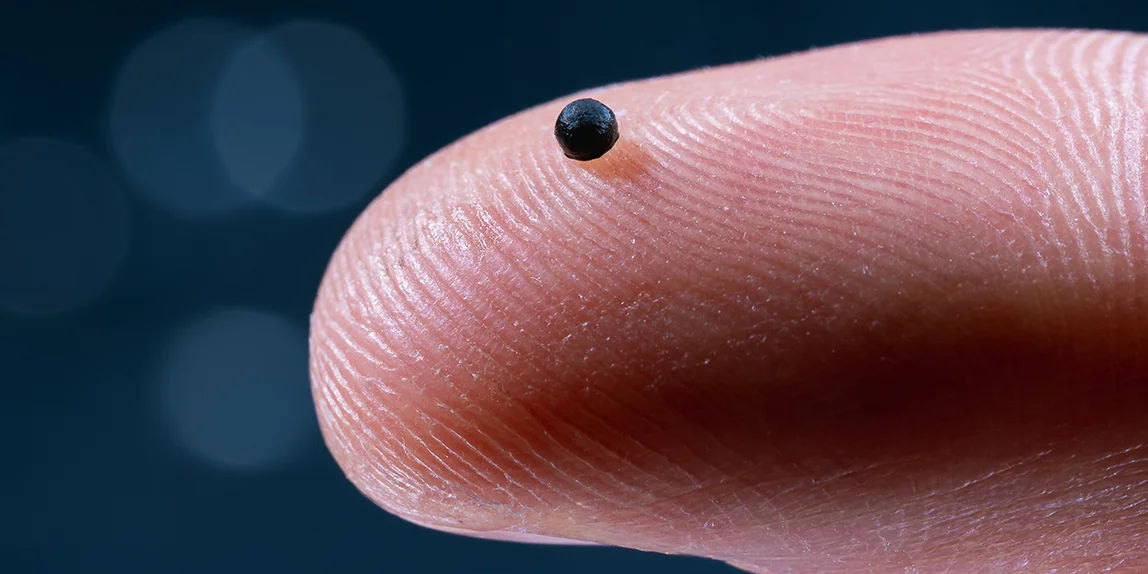
| Size | A gel sphere about 1.7 mm across (1.69 mm average in the 2025 preprint, sized for pig brain arteries), shown as a small dot on a fingertip in ETH's photo |
| Locomotion | No motors. External electromagnets roll it along vessel walls with a rotating field, pull it with field gradients, or nudge it into the right branch as blood carries it |
| Compute | None on board. Two coupled Navion electromagnetic navigation units (made by Zurich firm Magnebotix) create the steering fields, run by an operator |
| Camera | None on board. Tantalum nanoparticles make it visible on standard X-ray fluoroscopy |
| Sensors | None on board. Tracked from outside by C-arm X-ray at 30 fps |
| Runtime | Until released. A 510 kHz, 20 mT magnetic field heats it and dissolves the gel within about 40 seconds |
| Speed | Rolling about 4 mm/s (0.37 cm/s in the preprint, about 2 body lengths/s, estimate). Gradient pulling moves it against flows over 20 cm/s (21.2 cm/s in the preprint) |
| SDK | None |
Common questions
How much does ETH Zurich magnetic microrobot cost?
Not for sale. Academic research platform. The team aims for human clinical trials next.
Can ETH Zurich magnetic microrobot be bought today?
No. It was never sold to the public.
Who makes ETH Zurich magnetic microrobot?
ETH Zurich magnetic microrobot is made by ETH Zurich Multi-Scale Robotics Lab (Bradley Nelson, Salvador Pané) (Switzerland). It came out in 2025.
Can ETH Zurich magnetic microrobot be programmed?
No programmability.
Does ETH Zurich magnetic microrobot have AI chat or LLM support?
None. No built-in LLM and no SDK. Operators steer it with the lab's electromagnetic navigation system.
Ratings & reviews
Ratings and reviews load on the live site.
Similar robots
 Penn/Michigan programmable microrobotUniversity of Pennsylvania (Miskin Lab) / University of Michigan (Blaauw Lab) (USA)Not for sale
 DNA origami nanorobot (ASU / NCNST)Arizona State University (Hao Yan) / National Center for Nanoscience and Technology, Chinese Academy of Sciences (Baoquan Ding, Guangjun Nie, Yuliang Zhao)Not for sale
Sources
Science paper (2025) ↗ · arXiv preprint ↗ · Popular Science ↗