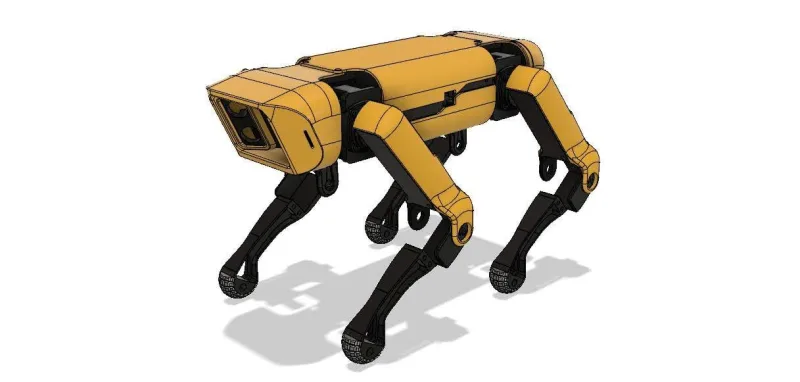
Spot Micro is a hobby-servo quadruped frame by Deok-yeon Kim (KDY0523), styled after the Boston Dynamics Spot, printed in plastic and driven by 12 high-torque servos. The original release was hardware only, so the community wrote several software stacks. The most-used one, by mike4192, runs ROS on a Raspberry Pi with walking gaits, RViz visualization and optional lidar SLAM.
At a glance
| Parts cost | $420–$510 estimated How Estimated for this page from current retail prices (2026-10-02) of the parts in the project parts list source ↗ Build priced mike4192's build on the KDY0523 frame (Raspberry Pi 3B, PCA9685, 12x PDI-HV5523MG, 2S LiPo, 5V UBEC); low excludes the optional RPLidar A1, high includes it Not included 3D printing, tools, shipping, tax; LiPo charger; laptop for ROS keyboard control; optional 16x2 I2C LCD |
|---|---|
| Difficulty | 3/5 Intermediate · Printing and servo calibration are approachable, but the main software needs ROS Kinetic on Ubuntu 16.04 or a community fork. |
| Build time | Not stated |
| Tools needed | 3D printer (full frame, many large parts), soldering for power wiring, hot glue for servo horns |
| Motors | 12 servos (original lists MG996R; mike4192 used PDI-HV5523MG; CLS6336HV variant parts exist) |
| Controller | Raspberry Pi 3B with PCA9685 servo board (original design used an Arduino Mega) |
| Sensors | Optional RPLidar A1, MPU-6050 or BNO055 IMU, HC-SR04 ultrasonic (original) |
| Published | ✓ Parts list✓ CAD/STL✓ Assembly guide✓ Wiring✓ Software✓ Video Thingiverse listing (STL + parts list + 2 assembly videos) + GitHub README and docs folder (mike4192) |
| Activity | Last update 2021-03-20 · 2,147 GitHub stars · mike4192 repo 2,147 stars and 504 forks; SpotMicroESP32 remix Discord; many Thingiverse remixes |
| Kits | No official kit; the design is widely remixed |
Licenses
| Design files | CC BY 4.0 (original Thingiverse frame) source ↗ |
|---|---|
| Code | MIT (mike4192/spotMicro) source ↗ |
| Documentation | MIT (README and docs folder in mike4192/spotMicro); SpotMicroAI docs site has no license found source ↗ |
Builder notes
Practical points from the project's issue tracker, forum and docs, each linked to its source.
- The MG996R servos named in the original parts list are too weak in practice. Builders reported robots that stand but fall when walking, and mike4192 confirmed his MG996R prototype was basically unusable before switching to PDI-HV5523MG servos. source ↗
- The reference software targets Ubuntu 16.04 and ROS Kinetic, and compiling on the Pi stalls without about 1 GB of swap. A community fork ports it to Ubuntu 20.04 and ROS Noetic. source ↗
- In 2025 mike4192 called the physical frame the weak point of the platform, and another builder published a redesign aimed at the shoulders and battery space. source ↗
- The SpotMicroAI GitLab group that many guides link to now redirects to a sign-in page, so the community code there is no longer publicly reachable. source ↗
- Moving the battery forward to shift the center of mass is the main fix suggested for wobbly or jerky walking. source ↗
Other quadrupeds plans
- Kame32 (MiniKame successor) · $90–$100 · difficulty 2/5
- Stanford Pupper (servo version) · $900–$1,000 (2024) · difficulty 3/5
- SpotMicroESP32 Leika · $230–$600 · difficulty 3/5
- Pupper v3 · $2,000 · difficulty 4/5
- ODRI Solo 12 · $7,100 (2022) · difficulty 5/5
- Mini Pupper (MangDang) · $760 · difficulty 2/5
- Dingo Quadruped · $900 · difficulty 3/5
- Stanford Pupper v2.1 (DJI motor version) · $1,600 (2023) · difficulty 4/5
- openDog V3 · $2,800–$3,400 (2023) · difficulty 4/5