Not for saleUniversity research prototype, first shown in 2019 and described in an October 2021 Science Robotics cover paper.
Not for sale (research)Not programmableWalks + fliesBipedalSlacklineSkateboard
Not for saleShipping: Not for sale. A research prototype that was never sold.
Remote control: Not possible. Research prototype.
Overview
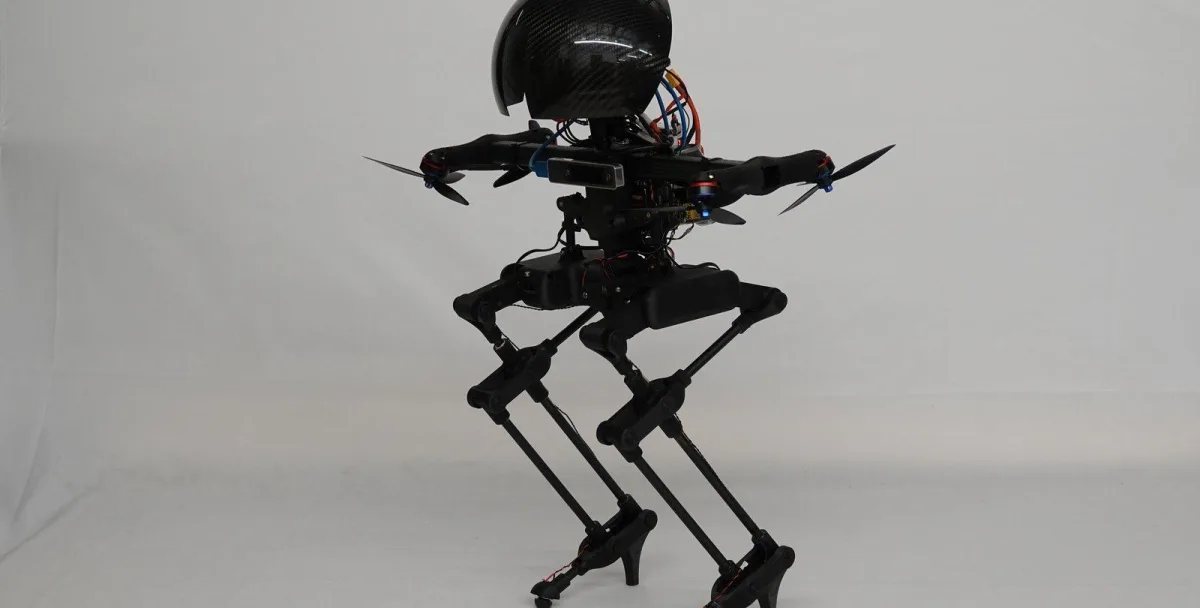
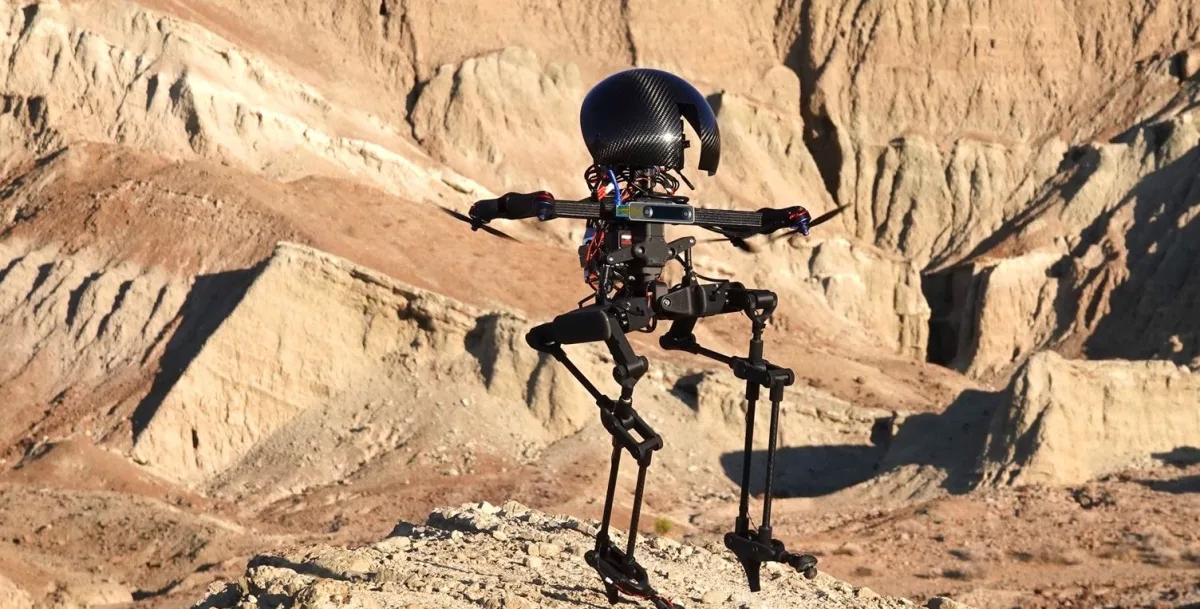
LEONARDO (LEgs ONboARD drOne, or LEO) is a two-legged robot with four drone propellers on its shoulders. The legs carry most of the weight while the propellers, controlled together with the leg joints, keep it balanced, so it can do things that are hard for ordinary walking robots. It walked on a slackline, rode a skateboard, hopped, and flew over obstacles between walking sections. Alireza Ramezani, later of the Northeastern lab behind Husky Carbon, helped build it. It remains a lab research platform.
Specifications
| Category | Drones · Fly + drive or walk |
|---|---|
| Released | 2019 |
| Country | USA |
| Availability | Not for sale (research) |
| Programmability | No programmability |
| Built-in autonomy | None / scripted · Moves only when controlled, or plays preset motions |
| LLM support | None · No built-in LLM and no SDK to connect one. |
| Best for | Professionals & labs |
| Vision sensors | Camera |
| Actuators | Mixed |
| Audio | No audio |
| Compute type | Rockchip, Arduino / ESP32 / microcontroller |
| Remote control | Not programmable |
| Size | About 0.7 to 0.8 m (2.5 ft) tall, 2.58 kg (5.7 lb) |
| Drive | Two legs with three actuated joints each, plus four propellers on the shoulders tilted inward 25 degrees. Leg joints use MKS HBL599 and Hitec HSB-9381TH servos, propellers use Garila X2508 2200 kV brushless motors. |
| Compute | NanoPC-T4 embedded computer (six cores, 4 GB RAM) plus an STM32F722 microcontroller |
| Vision | Intel RealSense T265 tracking camera (visual-inertial odometry) |
| Lidar | None |
| Sensors | ICM-20602 IMU, RealSense T265 VIO camera |
| Runtime | About 100 seconds of flight or 3.5 minutes of walking, limited by the 29 Wh propeller battery |
| Speed | Walking tested at 0.2 m/s, flight tested at 1 to 3 m/s |
| SDK | None public |
Ratings & reviews
Ratings and reviews load on the live site.
Similar robots
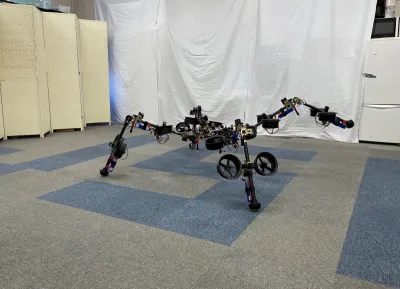 SPIDARJSK Lab (now DRAGON Lab), University of Tokyo (Japan)Not for sale
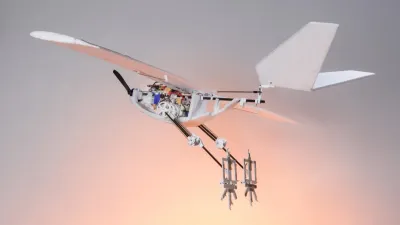 RAVENLaboratory of Intelligent Systems (LIS), EPFL (Switzerland)Not for sale
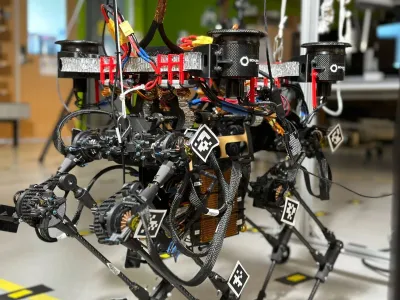 Husky CarbonSiliconSynapse Lab (Alireza Ramezani), Northeastern University (USA)Not for sale
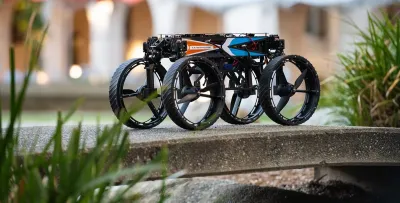 M4 (Multi-Modal Mobility Morphobot)Caltech CAST and Northeastern University (USA)Not for sale
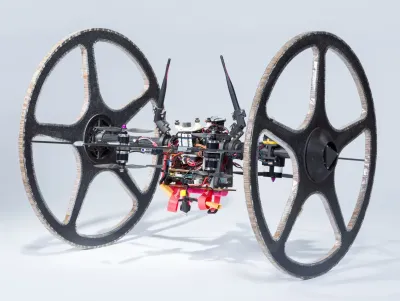 RollocopterTeam CoSTAR, NASA Jet Propulsion Laboratory (USA)Not for sale
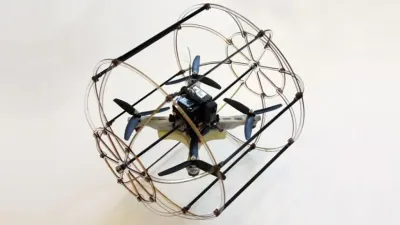 HyTAQRobotics Lab, Illinois Institute of Technology (USA)Not for sale