Actuators in brief
Robot dogs such as the Unitree Go2 and the MIT Mini Cheetah use quasi-direct-drive actuators. A brushless motor spins a single planetary gear stage, and a built-in field-oriented control driver sets the motor current. Because torque follows current, the controller can command torque directly, which reinforcement learning controllers rely on.
The gear ratio is how many times the motor turns for one turn of the output. Robot dog actuators use low ratios, about 6:1 to 10:1, so the joint can be pushed backward by hand. This property, called backdrivability, lets a leg absorb a landing like a spring and lets the motor sense the forces on the foot.
Spec sheets give two torques. Peak torque is what the actuator delivers for a second or two, as in a jump. Rated torque is what it can hold while turning without overheating. Rated figures usually assume an aluminum plate as a heat sink, so a joint mounted in plastic runs hotter than the sheet suggests. Bench tests on the RobStride RS00 measured how much hotter.
Gear ratio and inertia
A gearbox multiplies torque by its ratio, but it multiplies the rotor's inertia, as felt at the output, by the ratio squared. This reflected inertia is the extra mass the motor has to swing with every step, on top of the leg itself.
The MIT Mini Cheetah's rotor has an inertia of about 63 × 10⁻⁶ kg·m². Through its 6:1 gear stage that becomes 63 × 10⁻⁶ × 36, or about 0.0023 kg·m² at the output. The same rotor through 10:1 would reflect 0.0063 kg·m², nearly three times as much, for two thirds more torque.
Inertia matters because a trotting leg speeds up and slows down several times a second. A leg swinging half a radian each way four times a second reaches about 316 rad/s² of acceleration. At 0.0023 kg·m² that takes about 0.7 N·m just to move the rotor. At 0.009 kg·m² it takes about 2.8 N·m, a fifth of a 14 N·m actuator's peak. The extra torque becomes current, and the current becomes heat in the windings.
Low ratios therefore suit fast, light legs, and higher ratios suit joints that hold large loads at low speed. Many robot dogs use the same actuator at every joint. Some add a belt or a linkage at the knee to raise the ratio there alone, as the Mini Cheetah does with its 9.33:1 knee.
What makers publish
Only a few makers print an inertia figure. CubeMars lists one on most AK series pages, in g·cm², and labels the AK60-6 figure as rotor inertia. RobStride added an output-side figure for every model to its series specification in October 2026. DAMIAO's figures for its 43 series appear in Seeed Studio's parameter table without naming the side. Unitree, SteadyWin, Xiaomi, mjbots and T-MOTOR publish none for these actuators.
Where a figure is printed, it is worth checking whether it refers to the rotor or the output, since the two differ by the ratio squared. Some figures do not fit together even within one maker's documents. Simulation models often assume a round number, such as the 0.01 kg·m² that MuJoCo Menagerie's Go2 model uses for every joint. A bench test is the only way to know the real value for a given actuator.
Actuators compared
Prices are in US dollars and were checked in October 2026. "Listed inertia" is the maker's figure as printed. Each name links to its card in the Servo Guide, which has full specs and sources.
| Actuator | Peak / rated torque | Ratio | Weight | Price | Listed inertia | US stock |
|---|---|---|---|---|---|---|
| CubeMars AK60-6 V3.0 | 9 / 3 N·m | 6:1 | 380 g | $229.90 – $337.76 | 243.5 g·cm² rotor | RobotShop |
| CubeMars AK80-6 | 12 / 6 N·m | 6:1 | 485 g | $469.90 – $643.99 | 607 g·cm² | Special order |
| DAMIAO DM-J6006-2EC | 11–12 / 4 N·m | 6:1 | 335 g | $150 | Not published | No, ships from China |
| Unitree GO-M8010-6 | 23.7 N·m peak | 6.33:1 | about 530 g | $369 | Not published | No, ships from China |
| RobStride 02 | 17 / 6–7 N·m | 7.75:1 | 380–418 g | $145 – $190 | 0.0042 kg·m² output | Seeed Studio, Amazon |
| Xiaomi CyberGear | 12 / 4 N·m | 7.75:1 | 317 g | $179 – $188.90 | Not published | No, end of life |
| SteadyWin GIM8108-8 | 22 stall / 7.5 N·m | 8:1 | 396 g with driver | $93.89 – $221 | Not published | No, ships from China |
| CubeMars AK80-9 V3.0 | 22 / 9 N·m | 9:1 | 490 g | $479.90 – $655.29 | 1,118 g·cm² | RobotShop |
| RobStride 06 | 36 / 11 N·m | 9:1 | 621 g | $210 – $260 | 0.012 kg·m² output | Amazon |
| RobStride 00 | 14 / 5 N·m | 10:1 | 310 g | $125 – $138.99 | 0.001 kg·m² output | Seeed Studio |
| CubeMars AK70-10 | 24.8 / 8.3 N·m | 10:1 | 621 g | $398.90 – $563.76 | 753.5 g·cm² | RobotShop |
| mjbots qdd100 beta 3 | 16 / 3.3 N·m | not published | 507 g | $879 | Not published | Not stocked, 50-unit minimum |
| RobStride 10P | 42 / 14 N·m | 25:1 | 460 g | about $121 (¥859) | 0.00625 kg·m² output | No US seller found |
| DAMIAO DM-J4340-2EC | 27 / 9 N·m | 40:1 | 362–375 g | $155 – $240 | 2.0 × 10⁻⁵ kg·m² | No, ships from China |
The table is sorted by gear ratio. Units near the top swing fastest and reflect the least inertia, and units near the bottom give the most torque for their weight. The RobStride 10P and DAMIAO DM-J4340 run at 125 rpm and 100 rpm, so they suit arms and slow joints better than legs.
Choosing for a small robot dog
For scale, the 8.9 kg Xiaomi CyberDog 2 uses 12 N·m actuators, and the 12 kg Unitree Go1 uses 23.7 N·m units with an extra belt stage at the knee. RobStride's 00 and 02 give the most torque per gram and per dollar in that range, and they are the easiest to buy in the US. CubeMars's 6:1 units give up 2 to 5 N·m of peak torque but publish low rotor inertia, which favors fast leg swings. SteadyWin and DAMIAO sell similar torque for less money, with sparser English documentation and longer shipping.
Three questions narrow the choice. The first is whether the controller needs a documented torque command, such as the MIT-style position, velocity and torque frame that most quadruped software expects. The second is the weight budget per joint, since 100 g per joint adds 1.2 kg to a 12-joint robot. The third is heat, since a knee that runs near its rated torque while walking will reach its temperature limit within minutes.
Robots and their actuators
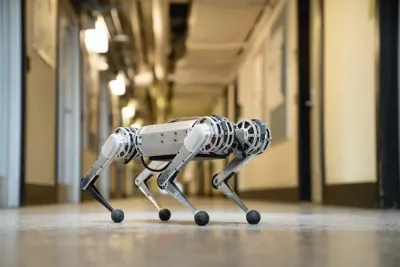 MIT Mini CheetahNot for sale
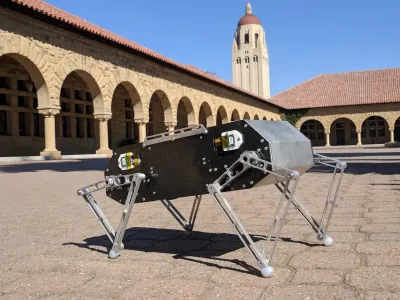 Stanford DoggoNot for sale
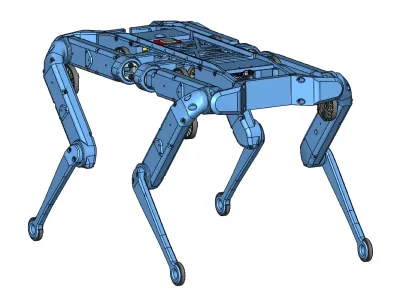 Solo 8 / Solo 12Not for sale (DIY)
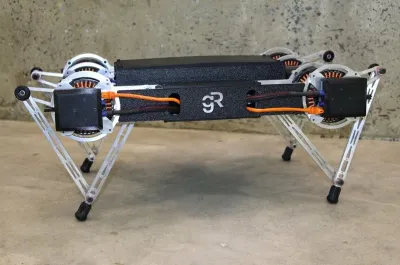 MinitaurWas ~$10,000 (quote)
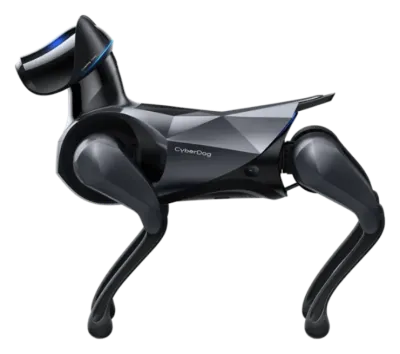 CyberDog 2~$1,800 – $3,000
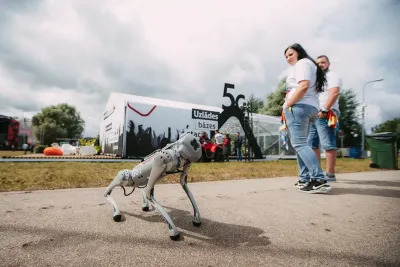 Go1Was $2,700 – $8,500+
- MIT Mini Cheetah pairs a large flat motor with a 6:1 planetary stage at every joint and a belt at the knee. The design became the template for most robot dog actuators sold today.
- Stanford Doggo and Ghost Robotics Minitaur use large drone-style outrunner motors with little or no gearing, which keeps reflected inertia close to zero.
- Solo 12, the Open Dynamic Robot Initiative's open-source quadruped, uses small T-MOTOR motors with a 9:1 belt reduction.
- Xiaomi CyberDog 2 uses Xiaomi's CyberGear actuators, which were also sold on their own until they reached end of life.
- Unitree Go1 uses the GO-M8010-6, which Unitree also sells on its own. Its knee adds a 1.5:1 belt stage on top of the 6.33:1 gearbox.
Buying in the US
Most of these actuators are made in China. In October 2026 only RobStride units, through Seeed Studio's US warehouse and Amazon, and some CubeMars units, through RobotShop, were stocked in the US. Everything else shipped from China in one to six weeks. US import duty on China-made motors was about 41.5% in October 2026 according to third-party tariff tools, and US-stocked prices usually include it. Sellers that ship from China often leave the duty to be paid to the carrier on delivery.
Sources
- RobStride. Product information, series specification and manuals ↗, GitHub, October 2026.
- CubeMars. AK series product pages ↗.
- DAMIAO. 43 series parameter table ↗, Seeed Studio wiki.
- Mini Cheetah. MIT Cheetah-Software ↗, rotor inertia and gear ratios in the robot model. Benjamin Katz, A Low Cost Modular Actuator for Dynamic Robots ↗, MIT thesis, 2018.
- Simulation models. MuJoCo Menagerie Unitree Go2 model ↗.
- US sellers. Seeed Studio RobStride 00 ↗, RobotShop CubeMars AK60-6 V3.0 ↗.
- Tariffs. US tariff lookup for HTS 8501.31.40 ↗, Wove, October 2026.