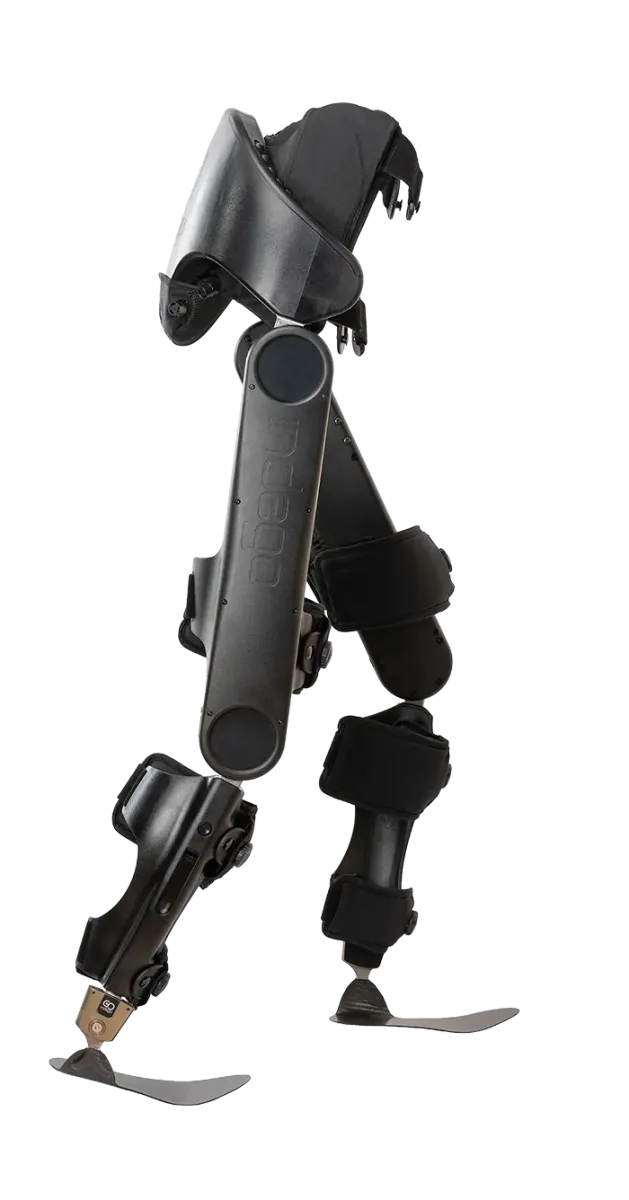
Overview
Indego began at Parker Hannifin, gained FDA clearance for personal and clinical use in 2016, and moved to Ekso Bionics in December 2022, which now sells it as the Ekso Indego Personal alongside the clinic-only Ekso Indego Therapy. At 14 kg it is one of the lightest personal exoskeletons, and its five-piece modular design with quick connectors lets it be assembled while seated in a wheelchair and packed into a car. It is FDA cleared for home and community use by people with spinal cord injury at T3–L5 (C7–L5 in institutions) and for stroke hemiplegia in clinics, and fits wearers from about 155 to 191 cm up to 113 kg with a Modified Ashworth spasticity score of 3 or lower. Buyers need a prescription, device training, and a trained support person present whenever it is used. Medicare's K1007 payment since April 2024 made it the first personal exoskeleton with routine federal coverage, and the VA and workers' compensation also fund it. The rival ReWalk 7 adds stairs and curbs, and Wandercraft's Eve walks without crutches. Wandercraft acquired Ekso on 2026-10-01 and says it will keep supporting Indego.
Specifications
| Category | Exoskeletons & exosuits · Medical & rehabilitation |
|---|---|
| Released | 2016 |
| Country | USA |
| Availability | Available |
| Programmability | No SDK, app / visual programming only |
| Built-in autonomy | Reactive · Responds to its surroundings without a map, such as avoiding obstacles or following a person |
| LLM support | None · No voice assistant or LLM. |
| Best for | Ages 18+ (maker rating) |
| Vision sensors | No vision sensors |
| Actuators | Brushless / direct-drive motors |
| Audio | No audio |
| Compute type | Proprietary / undisclosed |
| Control | App-adjusted |
| Weight | 14 kg (31 lb) |
| Assistance | Powered hips and knees stand a person with a spinal cord injury (T3–L5) up from a wheelchair and walk them with crutches or a walker. Leaning forward starts standing and walking, standing upright stops, and leaning back sits down. It handles carpet, floors, grass and asphalt but not stairs. |
| Joints | Hips & knees |
| Battery & runtime | Lithium-ion battery packs. Runtime is not published (unconfirmed). |
| Operation | Posture-based, with an iOS or Android app over Bluetooth to set speed and step height and review performance. LED colours and vibration give status feedback. |
| Sensors | Tilt and inertial sensors for posture detection plus joint encoders (details not published). Some models add a functional electrical stimulation (FES) interface. |
| Compute | Not published |
| SDK | None |
Ratings & reviews
Ratings and reviews load on the live site.
Similar robots
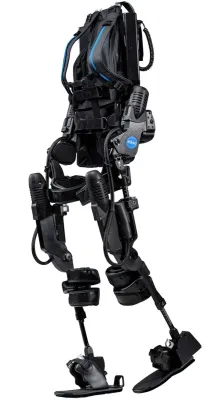 EksoNR
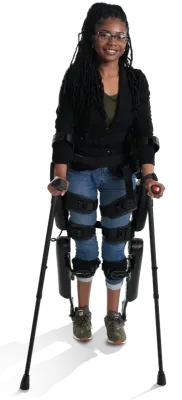 ReWalk 7 Personal Exoskeleton
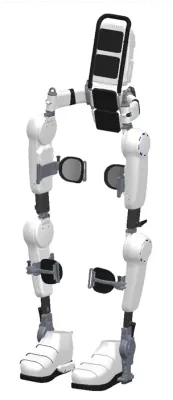 Medical HAL Lower Limb Type
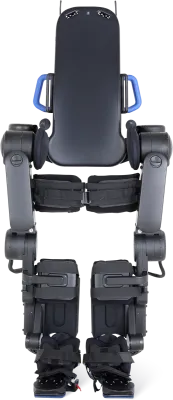 Atalante X
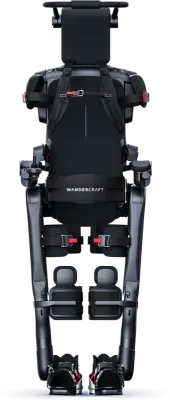 Eve
Eve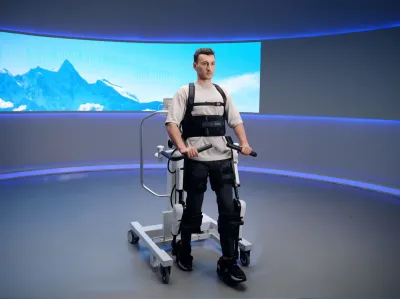 ExoMotus M4
Image credits
- Image 1: source (official product image)