Overview
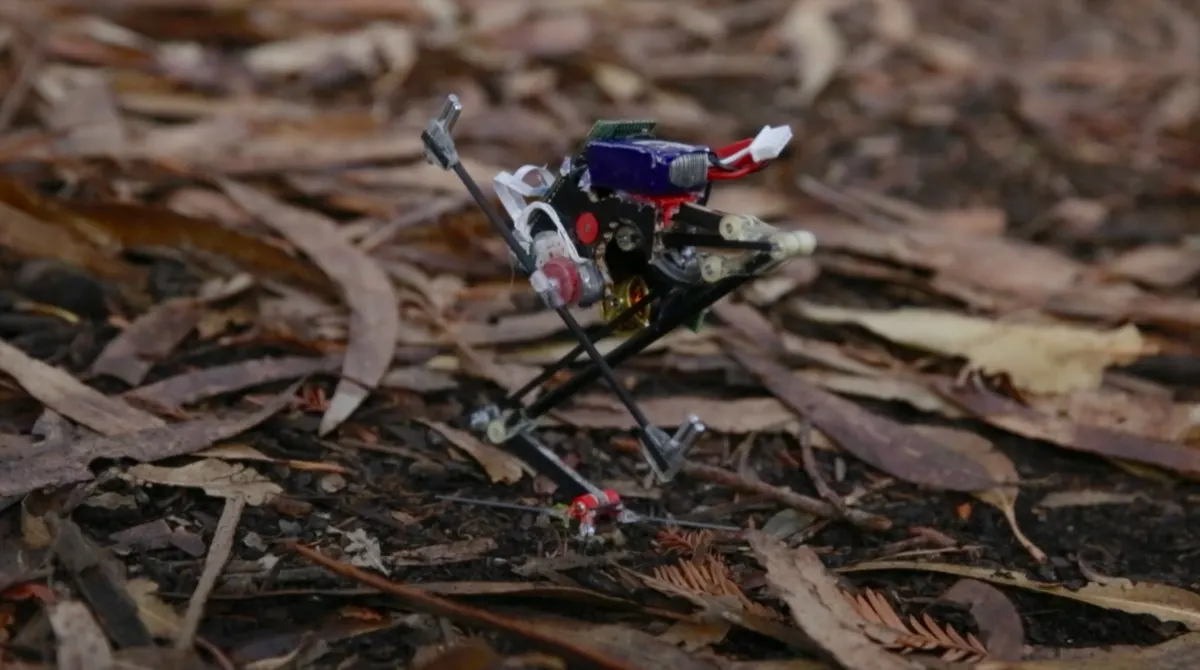
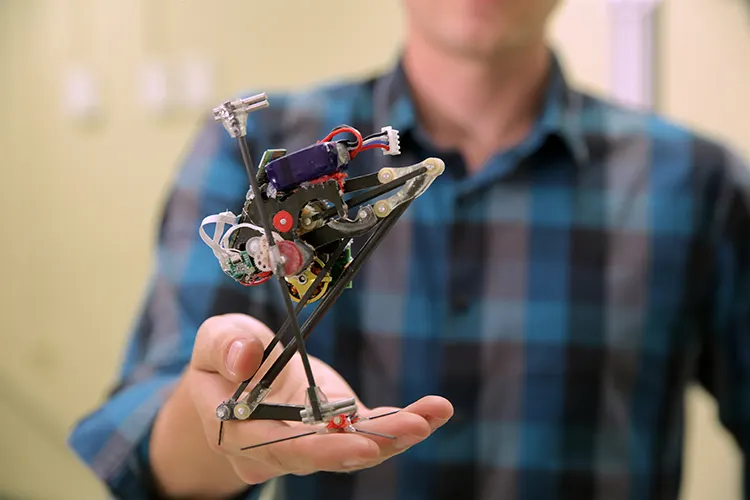
The robot that introduced 'vertical jumping agility' as a metric, modeled on the galago, which can chain jumps to 8.5 m in four seconds. Published in the first issue of Science Robotics (December 2016), SALTO scored 1.75 m/s, beating a bullfrog and reaching 78% of a galago, and could ricochet off a wall. The follow-on SALTO-1P (IROS 2017, 98 g) added aerodynamic thrusters and an inertial tail so it could hop continuously and steer in 3D, reaching a 1.25 m standing leap, and follow-up work (IROS 2018) studied the limits of precision jumping.
- Type
- Jumping robot · Jumping & hopping robots
- Maker
- UC Berkeley Biomimetic Millisystems Lab (USA)
- Released
- 2016
- Price
- Not for sale
- Status
- Not for sale (research)
- Best for
- Professionals & labs
- Programming
- No programmability
Price and shipping
University research robot. Funded by the US Army Research Laboratory and NSF.
Shipping: N/A. Not available. A university research platform.
Specifications
| Category | Jumpers & hoppers · Jumping & hopping robots |
|---|---|
| Released | 2016 |
| Country | USA |
| Availability | Not for sale (research) |
| Jumping Robots | Ranked #3 by jump height |
| Programmability | No programmability |
| Built-in autonomy | None / scripted · Moves only when controlled, or plays preset motions |
| LLM support | None · No built-in LLM and no SDK to connect one. |
| Best for | Professionals & labs |
| Vision sensors | No vision sensors |
| Actuators | Unknown |
| Audio | No audio |
| Compute type | Arduino / ESP32 / microcontroller |
| Remote control | Not programmable |
| Size | 26 cm tall fully extended, 100 g (original SALTO) |
| Locomotion | Single leg, a motor loads a latex series-elastic spring through a variable-mechanical-advantage eight-bar leg linkage ('power modulation'), SALTO-1P adds an inertial tail and two small propeller thrusters for aerial attitude control |
| Compute | ImageProc control board with a dsPIC33FJ128MC706A microcontroller and XBee radio (used on both SALTO and SALTO-1P) |
| Camera | None |
| Sensors | MPU-6000 6-axis IMU plus magnetic encoders on the leg linkage, leg motor and tail (SALTO-1P), external motion capture for position in most experiments |
| Runtime | Not published |
| Speed | Vertical jumping agility 1.75 m/s, single jumps to ~1.0 m, wall jump gains ~1.21 m |
| SDK | None public (lab code) |
Common questions
How much does SALTO / SALTO-1P cost?
Not for sale. University research robot. Funded by the US Army Research Laboratory and NSF.
Can SALTO / SALTO-1P be bought today?
No. It was never sold to the public.
Who makes SALTO / SALTO-1P?
SALTO / SALTO-1P is made by UC Berkeley Biomimetic Millisystems Lab (USA). It came out in 2016.
Can SALTO / SALTO-1P be programmed?
No programmability. None public (lab code).
Does SALTO / SALTO-1P have AI chat or LLM support?
None. No built-in LLM and no SDK to connect one.
Ratings & reviews
Ratings and reviews load on the live site.
Related guides
- Jumping Robots · the top 10 ranked by jump height
Similar robots
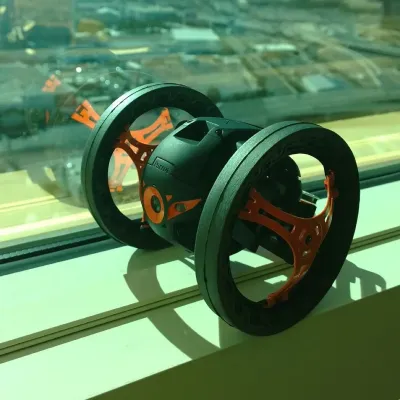 Parrot Jumping Sumo (and Jumping Race / Night)Parrot (France)Was $159.99 (2014)
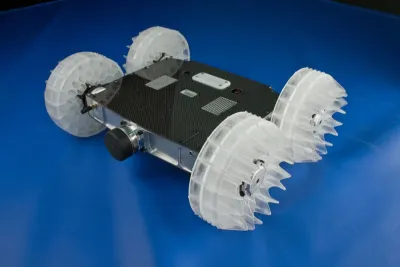 Sand FleaBoston Dynamics (USA)Not for sale
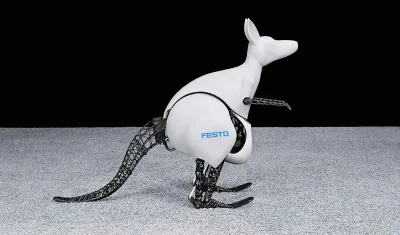 BionicKangarooFesto Bionic Learning Network (Germany)Not for sale
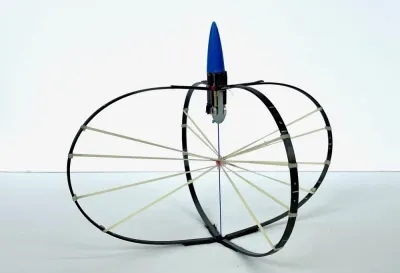 UCSB 30-Meter JumperUC Santa Barbara Hawkes Lab with Disney Research and Caltech (USA)Not for sale
 SpaceHopperETH Zurich Robotic Systems Lab student focus project (Switzerland)Not for sale
 Disney Research One-Legged Hopper (LEAP)Disney Research (USA)Not for sale