Top 10 robots ranked by jump height
Robots are ranked by peak height gained, straight up or up and forward. Long-jump distance and jumps down from a ledge don't count. The figures were measured in different ways, so close ranks are approximate. Measuring jump height explains the differences.
- 1
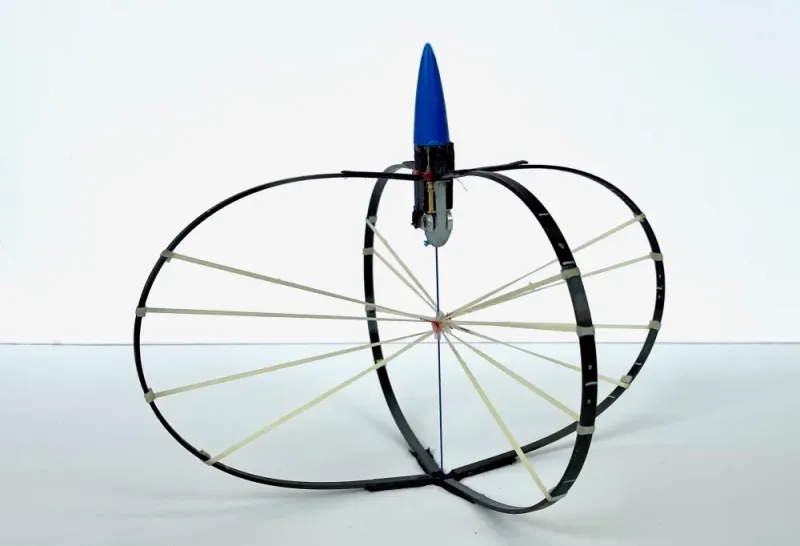
UCSB 30-Meter Jumper
Jump 32.9 m (108 ft) straight upCost Not sold
A small motor slowly winds a line onto a spindle, bending carbon-fiber bows and stretching rubber bands into one large spring. A latch then lets it all go at once, launching the 30 g device at over 28 m/s (63 mph). It is the highest jump of any known jumper, engineered or living.
Elliot Hawkes' lab at UC Santa Barbara built it in 2022 to show that a motor storing energy over many turns can beat the limits of muscle. The team pointed to hopping explorers for the Moon, where the same device would reach about 125 m (calculated). No build cost was published.
- 2
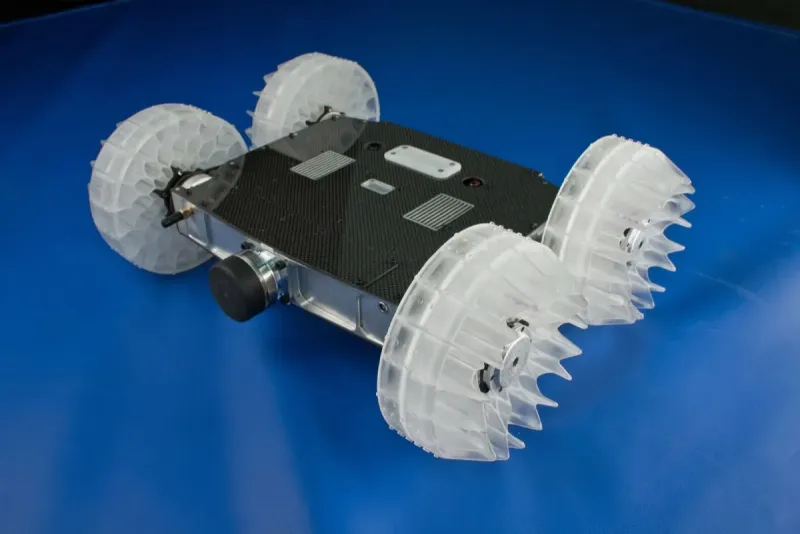
Sand Flea
Jump up to 10 m (33 ft) up and forwardCost Not sold
A 5 kg (11 lb) wheeled scout that tilts up and fires a CO2-powered piston into the ground. One cartridge gives about 25 jumps. Its spinning wheels act as gyros in flight, keeping it level so the camera stays usable.
Boston Dynamics built it in 2012 for the US Army from a Sandia National Laboratories design, to hop onto roofs and over walls for scouting. Guinness listed it as the highest jumping robot at the time. It stayed a military prototype and was never sold.
- 3
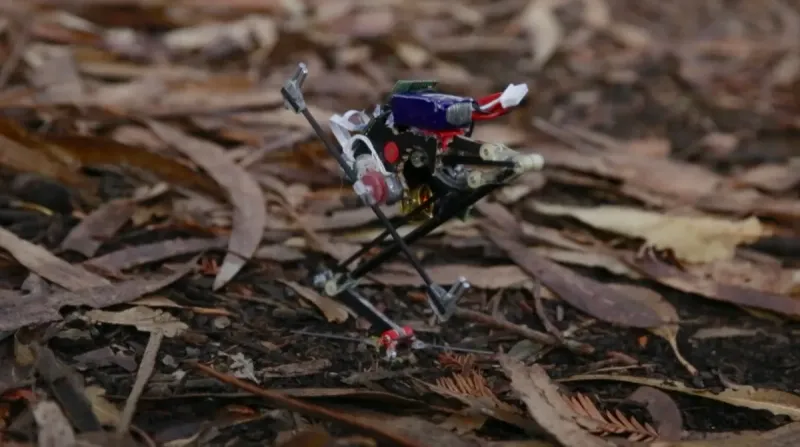
SALTO-1P
Jump 1.25 m (4.1 ft) straight upCost Not sold
A tiny one-legged hopper from UC Berkeley. A motor loads a latex spring through a linkage that slows the release, a trick copied from the tendons of the galago, a small primate. The original 2016 SALTO jumped about 1.0 m and could bounce off walls. SALTO-1P added a tail and two small thrusters, so it can hop continuously and steer.
It was built to study vertical jumping agility, how much height a robot gains per second of repeated jumping. Search and rescue over rubble was a stated goal. No cost was published.
- 4
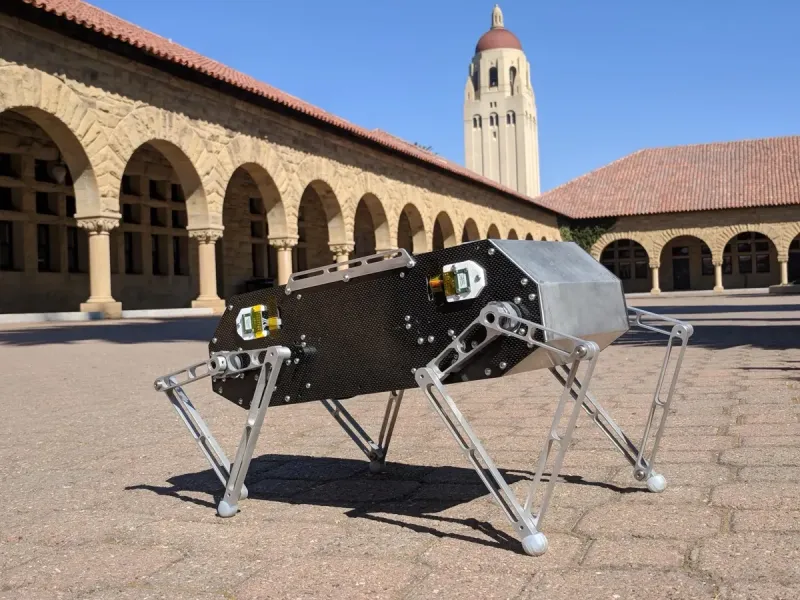
Stanford Doggo
Jump 1.14 m (3.7 ft) straight up, from a crouchCost Under $3,000 in parts (2019)
A student-built quadruped that uses off-the-shelf brushless motors with belt reductions instead of gearboxes. A Teensy microcontroller runs fast torque control on the legs. Its paper measures the jump as the rise of its center of mass from the lowest crouch to the top of the jump. That method reads higher than a rise measured from standing.
Stanford students built it in 2019 to show that a cheap, open-source robot dog could match far costlier lab robots in agility. It was never sold, but the paper puts its materials and machining at under $3,000.
- 5
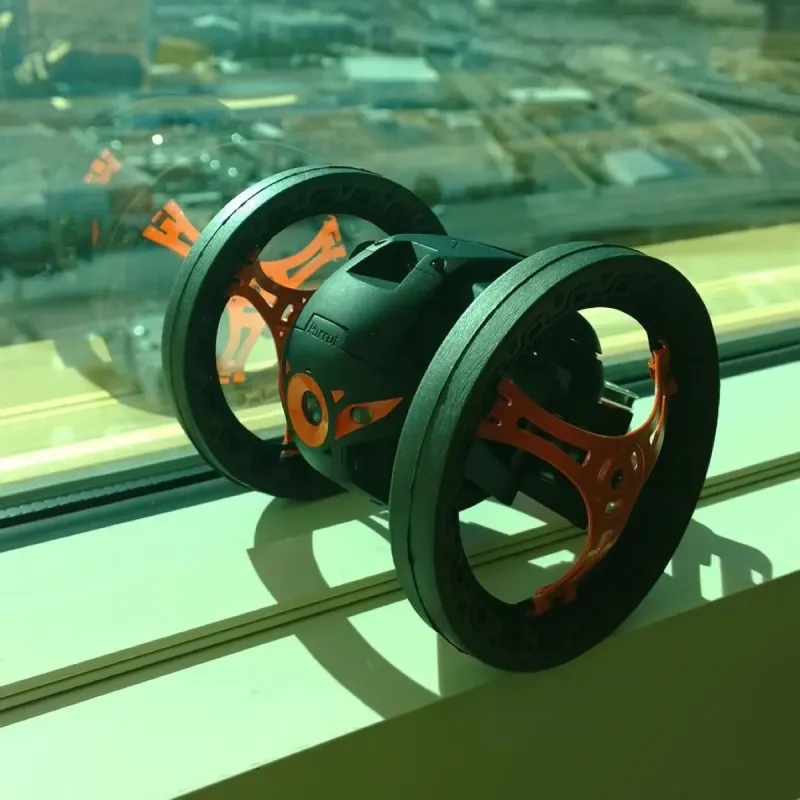
Parrot Jumping Sumo
Jump up to 80 cm (31 in) onto a step or tableCost Was $159.99 (2014)
A two-wheeled Wi-Fi toy that winds up a spring in its folding tail, then releases it to kick itself into the air and land back on its wheels. The same spring can kick objects. Reviewers reported jumps of about the rated height.
Parrot sold it as a phone-controlled consumer robot from 2014. It is the only robot on this list that was ever sold in toy stores.
- 6
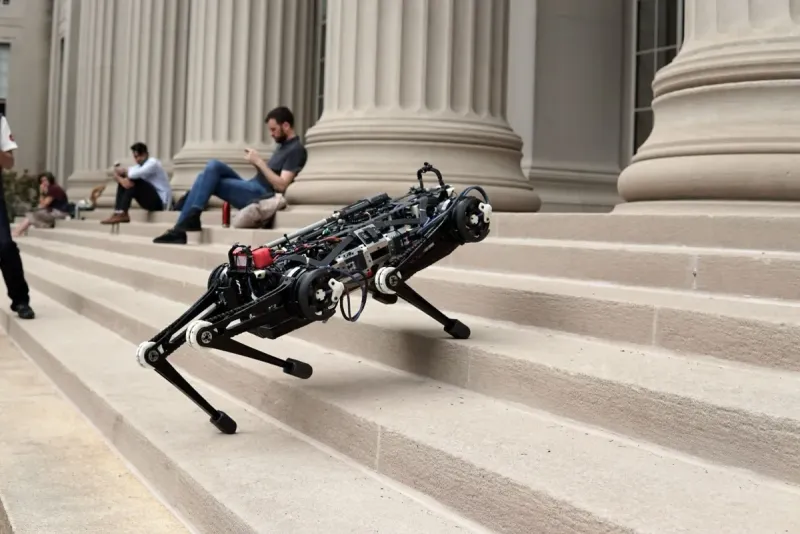
MIT Cheetah 3
Jump 78.74 cm (31 in) onto a platformCost Not sold
A 45 kg (99 lb) robot dog that holds the Guinness record for the highest jump by a quadruped robot. It made the jump from standing, landing on a platform taller than itself. Its electric motors use single-stage planetary gears, so the controller can sense and set leg forces without force sensors.
MIT's Biomimetic Robotics Lab built it for blind walking over stairs and debris, aimed at inspecting hazardous sites. It stayed a lab robot, and its actuator design carried over to the smaller Mini Cheetah.
- 7
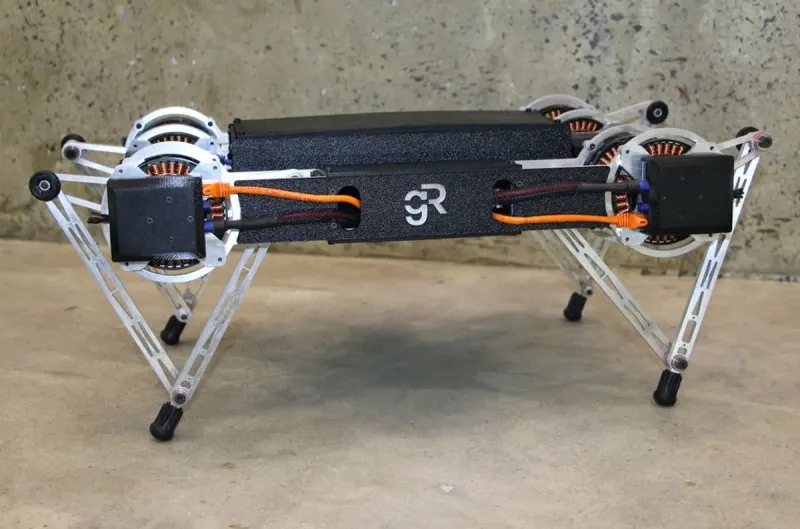
Minitaur
Jump 48 cm (19 in) straight up, repeatedCost Was about $10,000 (2016)
A 5 kg quadruped whose brushless motors drive the legs directly, with no gearbox. That lets the motors feel the ground through the legs. Guinness lists it as the most vertically agile quadruped robot, for 48 cm jumps made every 0.43 seconds.
It came out of the University of Pennsylvania and became Ghost Robotics' first product, sold to research labs. It could also climb fences and open doors.
- 8
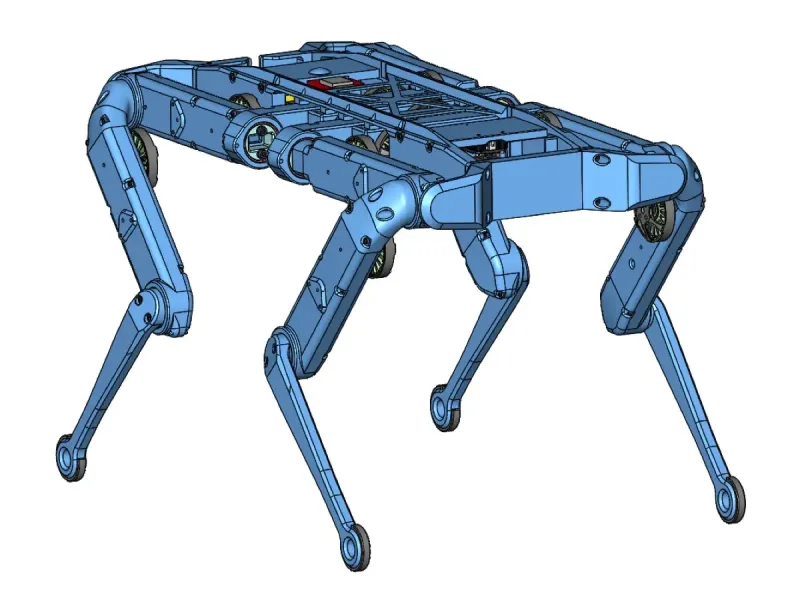
ODRI Solo 8
Jump 41 cm (16 in) straight up, from standingCost About $4,500 (€4,000) in parts
A 2.2 kg open-source robot dog with torque-controlled brushless motors and belt reductions. In its 2020 paper the body rose from a 24 cm standing height to 65 cm, and it landed undamaged. Measured from its crouch, as Doggo's jump was, the rise would be about 50 cm (estimate).
The Open Dynamic Robot Initiative built it as a low-cost research platform that any lab can copy, and the later Solo 12 added sideways hip joints. Its design files are free, and the Solo 12 build plan covers both.
- 9
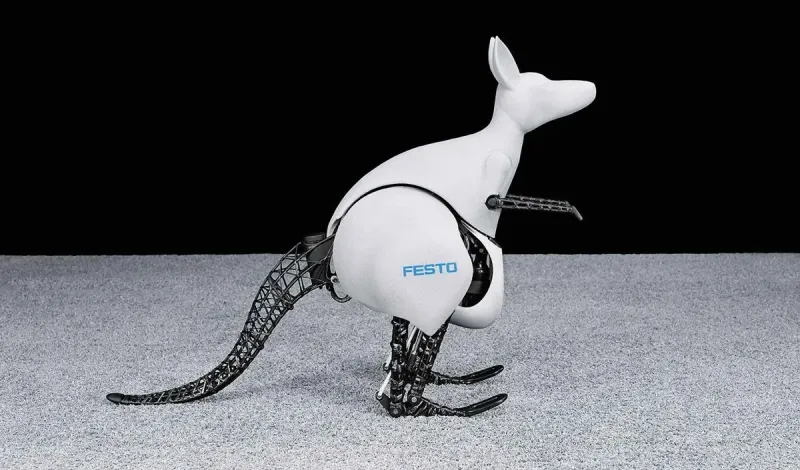
Festo BionicKangaroo
Jump up to 40 cm (16 in) high and 80 cm longCost Not sold
A 7 kg (15 lb) robot kangaroo that jumps with pneumatic cylinders in its legs. An elastic "Achilles tendon" is tightened with air before the first jump, then recharged by each landing. The energy carries over from one hop to the next, as in a real kangaroo.
Festo built it in 2014 as a trade-fair demonstrator of energy recovery and control. It was never sold.
- 9
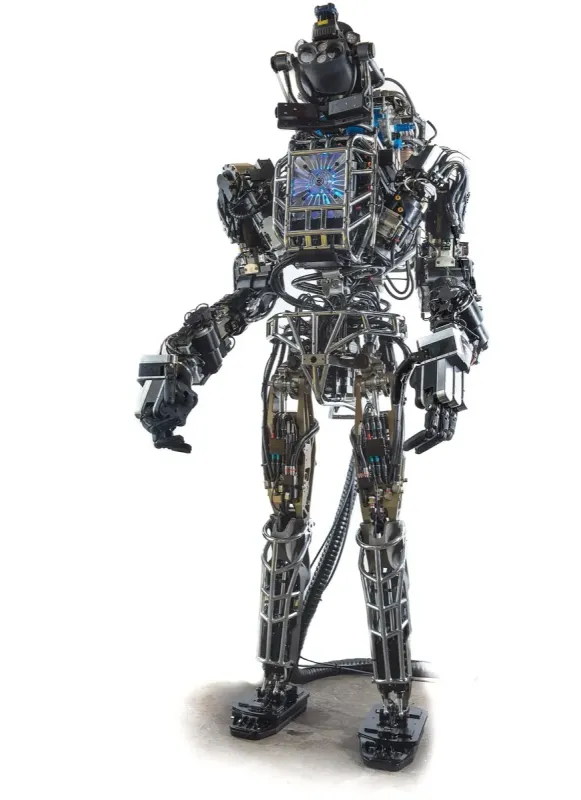
Atlas (hydraulic)
Jump 40 cm (16 in) per box, up and forwardCost Not sold
Boston Dynamics' humanoid jumped up a row of 40 cm boxes without stopping in its 2018 parkour video. Hydraulic actuators give it the power, and whole-body control software plans each jump. Higher boxes in other videos look taller than 40 cm, but no heights were published (unconfirmed).
Atlas was built for the DARPA Robotics Challenge and then served as Boston Dynamics' research humanoid until 2024. The electric Atlas replaced it. It was never sold, and no price was published.
Near misses
- Ascento. The 2019 ETH Zurich research version of this wheel-legged robot jumped 40 cm, tying the last two places. Its site entry is the later Ascento Guard security robot, which has no published jump.
- AgiBot D1. Resellers list a 35 cm jump, but AgiBot doesn't publish one (unconfirmed).
- Unitree B2 and Unitree G1. Unitree lists long jumps of 1.6 m and 1.4 m. A jump that long would peak roughly 20 to 40 cm above the ground (estimate).
- Unitree B2-W. Its widely reported 2.8 m jump was down from a ledge.
- Unitree "Superman". Unitree claimed a 2 m standing jump for this humanoid in an August 2026 video. It has no product page or independent measurement, so it isn't ranked.
Measuring jump height
No standard test exists for robot jumps, so each team reports its own measure. The numbers above fall into a few groups.
- Rise from a crouch. Doggo's figure starts from its lowest crouch, so it reads higher than a rise from standing.
- Rise from standing. Solo 8's figure, the stricter measure.
- Peak height of the whole device. Used for the UCSB jumper and SALTO, which are tiny and light.
- Height of a platform landed on. Used for Cheetah 3, Atlas and Jumping Sumo. The robot only needs to get its feet or wheels over the edge, and it can tuck its legs.
- Maker "up to" figures. Rated maximums for Jumping Sumo, BionicKangaroo and Sand Flea, rather than lab measurements.
- Repeated jumps. Minitaur's 48 cm is for jumps made every 0.43 seconds, which is harder than one best jump.
Size matters too. A 30 g spring launcher and a humanoid face very different physics, and this list compares raw height rather than height relative to body size.
Requirements for jumping
Walking robots can get by with modest motors and a simple controller. Jumping is much harder, since the robot has to release a lot of energy in a fraction of a second and then survive the landing.
Power from motors or springs
Robots on this list get their jump in one of two ways.
- Stored energy. The UCSB jumper, SALTO, Jumping Sumo, Sand Flea and BionicKangaroo store energy slowly in a spring, a gas cartridge or air pressure, then release it all at once. A small motor can wind a big spring, which is why the highest jumpers are tiny single-purpose devices.
- Direct motor power. Robot dogs like Doggo, Minitaur, Solo and Cheetah 3 push off with their leg motors alone. That calls for brushless motors with high torque for their weight.
Motor-driven jumpers use little or no gearing, usually under about 10:1 (called quasi-direct drive). Low gearing lets the legs move fast and lets the motor feel and soften the landing. Hobby servos have high gear ratios, so servo robot dogs manage small hops at most, whatever computer drives them. Their gears also tend to strip on a hard landing.
Control during the jump
A walking robot can replay a fixed table of joint angles. A jumping robot instead controls the force in each leg, using a loop that runs about 500 to 1,000 times a second. A jump has four phases.
- Crouch. The legs bend to give a long push.
- Push-off. The motors drive the legs with a timed force profile, and all legs have to stay in sync so the body doesn't tip.
- Flight. The legs pull in and swing into position for landing. A tail, as on SALTO, or spinning wheels, as on Sand Flea, can keep the body level.
- Landing. The legs act like springs to absorb the impact rather than locking stiff.
Teams usually tune this in a physics simulator such as MuJoCo or Isaac Gym before risking the hardware.
Computer and electronics
Jumping doesn't need a powerful computer. Doggo ran its jumps on a Teensy microcontroller, and most of the force control happens in each motor's own driver. A Jetson or Raspberry Pi only becomes useful when the robot also needs cameras, mapping or learned control.
The power system matters more. During push-off, every motor draws a large burst of current at once, so jumping robots use high-discharge batteries and thick wiring. Energy flowing back from the motors on landing can push the voltage high enough to damage the drivers, so the electronics need a way to absorb it.
Frame and safety
Landing forces can be several times the robot's weight. Frames are usually aluminum, carbon fiber or tough printed nylon rather than standard PLA, which can crack. Bearings, belts and screws all take shock loads. Motors strong enough to jump can also injure fingers, so builders test new jumps on a tether or a vertical rail. A single leg on a rail is a common first step, as in the Overleap jumping leg build plan.