Quick picks for robots
| Job | Best fit | Why |
|---|---|---|
| Vision, ROS 2, mapping | Pi 5, 4 GB or 8 GB | About two to three times faster than a Pi 4, with PCIe for an AI accelerator or SSD |
| Kits that list a Pi 4 | Pi 4, 2 GB to 4 GB | Widest HAT and library support, lower power draw than a Pi 5 |
| Small, cheap or light robots | Zero 2 W | $15, 65 × 30 mm and about 350 mA, with Wi-Fi and a camera port |
| A custom circuit board | Compute Module 5 | Pi 5 power on a 55 × 40 mm card that plugs into a robot's own board |
| Motor and servo timing | Pico 2 | $5 microcontroller with exact timing, often paired with a bigger Pi |
| On-board object detection | AI HAT+ on a Pi 5, or the AI Camera | Runs detectors such as YOLO in real time without loading the CPU |
| A tight budget | Pi 5 1 GB ($45) or a used Pi 4 | Memory price rises since 2025 hit the 2 GB and larger boards hardest |
Current boards compared
All of these are still made, and Raspberry Pi promises to keep each in production until at least the year shown. Prices are official US list prices in October 2026. Raspberry Pi raised prices on boards with 2 GB or more memory five times between October 2025 and October 2026, as the cost of memory chips climbed, so many of these boards now cost two to three times what they did at launch. Resellers may charge slightly more or less.
| Board | Released | Processor | Memory | Price (Oct 2026) | Made until |
|---|---|---|---|---|---|
| Pi 5 | Oct 2023 | 4 × Cortex-A76, 2.4 GHz | 1, 2, 4, 8, 16 GB | $45 / $77.50 / $110 / $175 / $305 | 2036 |
| Pi 4 Model B | Jun 2019 | 4 × Cortex-A72, 1.8 GHz | 1, 2, 3, 4, 8 GB | $35 / $67.50 / $83.75 / $100 / $165 | 2034 |
| Pi 3 Model B+ | Mar 2018 | 4 × Cortex-A53, 1.4 GHz | 1 GB | $40 | 2030 |
| Pi 3 Model A+ | Nov 2018 | 4 × Cortex-A53, 1.4 GHz | 512 MB | $25 | 2030 |
| Pi 3 Model B | Feb 2016 | 4 × Cortex-A53, 1.2 GHz | 1 GB | $35 | 2028 |
| Zero 2 W | Oct 2021 | 4 × Cortex-A53, 1 GHz | 512 MB | $15 | 2030 |
| Zero W / WH | Feb 2017 | 1 × ARM11, 1 GHz | 512 MB | $10 / $14 | 2030 |
| Zero | Nov 2015 | 1 × ARM11, 1 GHz | 512 MB | $5 | 2030 |
| Compute Module 5 | Nov 2024 | 4 × Cortex-A76, 2.4 GHz | 2, 4, 8, 16 GB | From $67.50 | 2036 |
| Compute Module 4 | Oct 2020 | 4 × Cortex-A72, 1.5 GHz | 1, 2, 4, 8 GB | From $41.25 | 2034 |
| Pi 500+ | Sep 2025 | 4 × Cortex-A76, 2.4 GHz | 16 GB | $410 | 2035 |
| Pi 500 | Dec 2024 | 4 × Cortex-A76, 2.4 GHz | 8 GB | $180 | 2034 |
| Pi 400 | Nov 2020 | 4 × Cortex-A72, 1.8 GHz | 4 GB | $60 | 2028 |
The prices of the Pi 3, Zero and older boards are their long-standing list prices, which Raspberry Pi said it did not expect to change. Raspberry Pi does not list a price for every memory size, so the 4 GB and 8 GB prices for the Pi 4 and Pi 5, and the Pi 500 price, are worked out from its price-change announcements. Prices for the 16 GB Pi 5, the Pi 500+ and the cheapest Compute Modules come straight from Raspberry Pi's product pages.
Raspberry Pi 5
The Pi 5 is the fastest Raspberry Pi and the usual choice for new robots that see, map or think on board. Its Broadcom BCM2712 chip has four Cortex-A76 cores at 2.4 GHz and a VideoCore VII graphics processor. Raspberry Pi designed its own input/output chip, the RP1, which handles the USB, Ethernet, camera and GPIO connections.
- Connections. Two USB 3.0 and two USB 2.0 ports, gigabit Ethernet, dual-band Wi-Fi 5, Bluetooth 5.0, two micro-HDMI outputs, two four-lane camera or display connectors, a single-lane PCIe 2.0 connector, a fan header, a power button and a real-time clock.
- Power. A 5 V, 5 A USB-C supply. On a 3 A supply the USB ports are limited to 600 mA in total, which may not be enough for a lidar plus a USB camera. A bare board draws about 800 mA when busy.
- Memory. The 1 GB model handles simple control, but 4 GB or 8 GB suits ROS 2, SLAM and vision. The 16 GB model mainly helps with large language models run on the board.
- Common uses. ROS 2 rovers such as the MentorPi M1, UGV Rover and ROSbot 3, humanoid kits like the TonyPi Pro and AiNex, and LeRobot builds such as LeKiwi, where the Pi passes data to a laptop that runs the AI.
Some older robot add-on boards and code do not work on a Pi 5, since its GPIO pins run through the RP1 chip. The old RPi.GPIO library does not work, so code has to use gpiozero or lgpio instead, and the GoPiGo3 still does not support the Pi 5. The camera connectors also use a smaller 22-pin cable than the 15-pin cable of a Pi 4. The board has no 3.5 mm audio jack, so robots that talk use a USB, HDMI or I2S speaker. The Pi 5 runs hot under load, and Raspberry Pi's $5 Active Cooler is close to essential in a closed robot body.
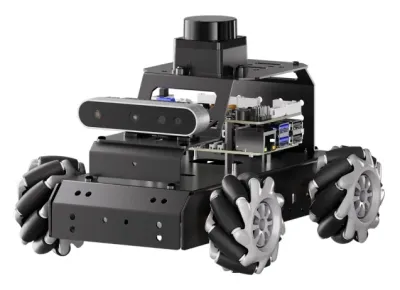 MentorPi M1$430 – $880
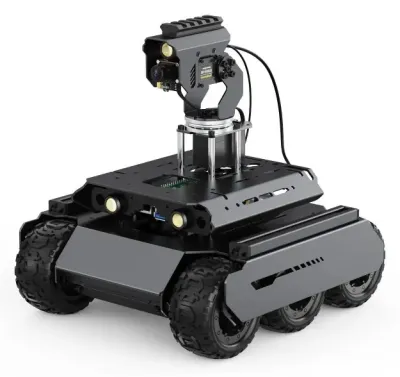 UGV Rover$245 – $727
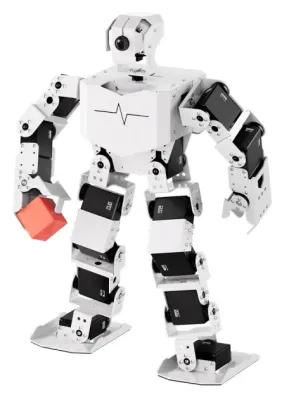 TonyPi Pro$889.99 – $1,169.99
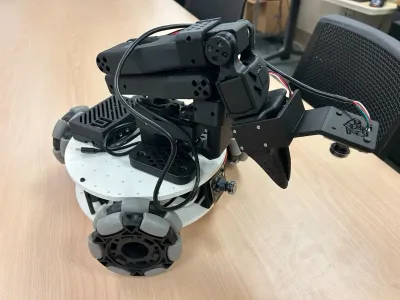 LeKiwi~$450 – $870 complete
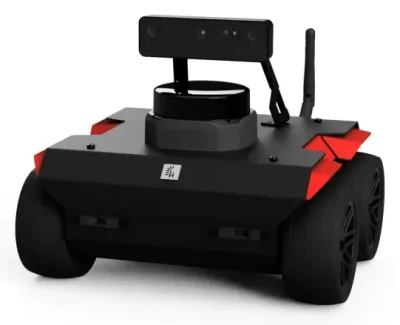 Husarion ROSbotFrom €2,749 (ROSbot 3) /…
Raspberry Pi 4 Model B
The Pi 4 was the standard robot brain from 2019 until the Pi 5 arrived, and many kits are still designed around it. It has four Cortex-A72 cores at 1.8 GHz, two USB 3.0 and two USB 2.0 ports, gigabit Ethernet, Wi-Fi 5, Bluetooth 5.0, two micro-HDMI outputs, one 15-pin camera connector, one display connector and a 3.5 mm audio jack. It needs a 5 V, 3 A USB-C supply and draws 0.6 A when idle and about 1.25 A at full load, less than a Pi 5.
A 3 GB model arrived in April 2026 as a cheaper step between the 2 GB and 4 GB versions. The Pi 4 is a good choice when a kit, HAT or tutorial specifically names it, when battery life matters more than speed, or when a 1 GB board ($35) is enough for driving motors and streaming video.
- Common uses. The TurtleBot 4 and TurtleBot 3 for ROS 2 teaching, the BlueROV2 underwater drone, the myCobot 280 Pi edition, the Donkey Car self-driving race car and the Mini Pupper 2.
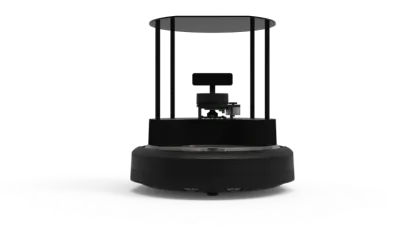 TurtleBot 4 / 4 Lite$1,572 / $2,575
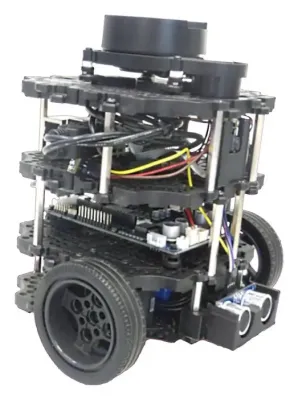 TurtleBot 3$758 – $1,934
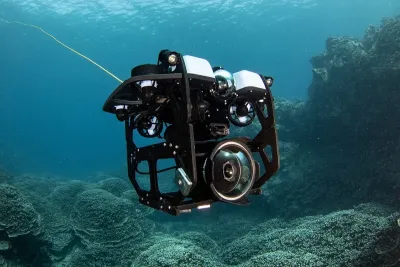 BlueROV2From $4,900
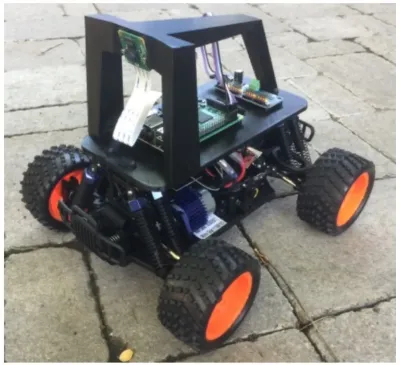 Donkey Car~$250–$500 (DIY, est.)
Raspberry Pi 3 (B, B+ and A+)
The Pi 3 family uses four Cortex-A53 cores at 1.2 to 1.4 GHz with 1 GB of memory (512 MB on the A+). It was the first Pi with built-in Wi-Fi and Bluetooth. The ports are all USB 2.0, and the B+ reaches only about 300 Mbit/s on Ethernet because it shares the USB connection. It runs from a 5 V, 2.5 A micro-USB supply. The Pi 3 still works for simple robots that follow lines, avoid obstacles or stream a camera, and many kits such as the PiCar-X, PiDog and GoPiGo3 accept one. It is too slow for modern vision models or comfortable ROS 2 use, and a Pi 4 1 GB costs about the same. The Yanshee humanoid uses a Pi 3B.
Raspberry Pi Zero family
The Zero boards are tiny (65 × 30 mm), light and very low-power, which suits small robots, drones and wearables. They have one micro-USB data port, a mini-HDMI output, a camera connector and an unsoldered 40-pin GPIO header.
- Zero 2 W ($15), the one to buy. Four Cortex-A53 cores at 1 GHz, 512 MB of memory, 2.4 GHz Wi-Fi and Bluetooth 4.2, drawing about 350 mA. It runs Python, OpenCV and camera streaming well, but 512 MB is too little for ROS 2 beyond a few light nodes. The Open Duck Mini v2 walking robot runs on one, and the PiCar-X and PiDog accept one.
- Zero W and WH ($10 and $14). The older single-core version with Wi-Fi, which is much slower. WH has the header already soldered on.
- Zero ($5). Single core with no wireless, which makes it hard to use in a robot.
A related Compute Module Zero (CM0), with the Zero 2 W's chip on a solder-down module, appeared in late 2025. Press reports say it is sold only in China (unconfirmed).
Compute Modules
A Compute Module is a Raspberry Pi shrunk onto a small card with no ports of its own. It plugs into a carrier board, which a robot maker designs to fit the robot's shape and add exactly the connectors it needs, such as motor drivers or extra cameras. Most versions add built-in eMMC flash storage, which survives vibration better than a microSD card, and optional Wi-Fi.
- Compute Module 5, with the Pi 5's processor, 2 to 16 GB of memory (with error correction), 0 to 64 GB of eMMC, PCIe, two USB 3.0 ports and two four-lane camera or display connections, on a 55 × 40 mm card. From $67.50. Used in the XGO-Rider2 and DOGZILLA-Lite.
- Compute Module 4, with the Pi 4's processor at 1.5 GHz, 1 to 8 GB of memory and up to 32 GB of eMMC. From $41.25. Used in the Mini Pupper 2, Doly and the wireless Reachy Mini. The CM4S is the same chip in an older laptop-memory (SODIMM) shape.
- Compute Module 3+, an older Pi 3-class module in the SODIMM shape, made until at least 2028.
Hobbyists who want a Compute Module need a carrier board too, such as Raspberry Pi's own CM5 IO Board or a third-party robot carrier. For most one-off builds a regular Pi 5 or Pi 4 is simpler.
Keyboard computers (Pi 400, 500, 500+)
These are a Pi built into a keyboard, meant as complete desktop computers. The Pi 400 ($60) has a Pi 4 inside with 4 GB, the Pi 500 ($180) a Pi 5 with 8 GB and a 32 GB card, and the Pi 500+ ($410) a Pi 5 with 16 GB, a mechanical keyboard and a 256 GB SSD. They are too large to ride on a robot, but make a tidy station for writing robot code, running a simulator or controlling a robot over Wi-Fi. Their GPIO pins sit on the back edge.
Older boards
These early boards are worth knowing when buying used kits. They are too slow for most modern robot software, and several are out of production.
| Board | Released | Processor | Memory | Status |
|---|---|---|---|---|
| Pi 2 Model B | Feb 2015 | 4 × Cortex-A7, 900 MHz (later Cortex-A53) | 1 GB | Early versions ended in 2025, the latest (v1.3) is still listed at $35 |
| Pi 1 Model B+ / A+ | 2014 | 1 × ARM11, 700 MHz | 512 MB (A+ 256 or 512 MB) | Still made until at least 2030, about $25 / $20 |
| Pi 1 Model B / A | 2012–2013 | 1 × ARM11, 700 MHz | 256 or 512 MB | Discontinued, with a 26-pin GPIO header |
| Compute Module 1, 3 and 3 Lite | 2014–2017 | ARM11 or Cortex-A53 | 512 MB to 1 GB | CM3 ended in October 2025. CM1 still sold at $25 |
Pico microcontrollers
The Pico boards are not small Linux computers but microcontrollers, built on Raspberry Pi's own chips. They run one program written in MicroPython, C or C++, start instantly and keep exact timing, so they are well suited to driving motors, reading encoders and generating servo signals. Their special PIO blocks can produce custom signals, such as the bus protocol of smart servos, without loading the processor. Many robots pair a Pico with a bigger Pi, which sends it commands over USB or UART.
| Board | Released | Chip | Memory | Wireless | Price |
|---|---|---|---|---|---|
| Pico 2 | Aug 2024 | RP2350, 2 × Cortex-M33 or RISC-V, 150 MHz | 520 KB RAM, 4 MB flash | No | $5 |
| Pico 2 W | Nov 2024 | RP2350 | 520 KB RAM, 4 MB flash | Wi-Fi 4, Bluetooth 5.2 | $7 |
| Pico / Pico H | Jan 2021 | RP2040, 2 × Cortex-M0+, 133 MHz | 264 KB RAM, 2 MB flash | No | $4 / $5 |
| Pico W / WH | Jun 2022 | RP2040 | 264 KB RAM, 2 MB flash | Wi-Fi 4, Bluetooth 5.2 | $6 / $7 |
The H versions come with headers soldered on. The RP2040 chip also appears in the Pololu 3pi+ 2040 and Zumo 2040 robots, and the H.I.R.O. robot dog design runs on a Pico 2 W.
AI accelerators and the AI Camera
A Raspberry Pi's processor can run small vision models, but only a few frames per second. Raspberry Pi sells add-ons with a dedicated NPU that run object detection, pose tracking and similar models many times faster, while the main processor stays free for driving and planning. Speed is measured in TOPS, trillions of operations per second.
| Add-on | Chip and speed | Works with | Price | Best for |
|---|---|---|---|---|
| AI HAT+ (13 TOPS) | Hailo-8L, 13 TOPS | Pi 5 only | $70 | Real-time object detection and pose tracking on one camera |
| AI HAT+ (26 TOPS) | Hailo-8, 26 TOPS | Pi 5 only | $110 | Larger models or two cameras at once |
| AI HAT+ 2 | Hailo-10H, 40 TOPS, 8 GB of its own memory | Pi 5 only | $200 | Small language and vision-language models (about 1 to 1.5 billion parameters) as well as detection |
| AI Camera | Sony IMX500 12 MP sensor with built-in AI processing | Every Pi, including the Zero 2 W | $70 | Detection on small, low-power robots, since the camera does the work |
| AI Kit | Hailo-8L, 13 TOPS on an M.2 board | Pi 5 only | Was $70 | Discontinued and replaced by the AI HAT+ |
The AI HATs sit on top of a Pi 5 and connect through its PCIe port, so they cannot be used together with a PCIe SSD unless an extra adapter board is added. The AI HAT+ 2 launched at $130 in January 2026 and rose with the memory-driven price increases. For larger models and faster AI, robots move up to an NVIDIA Jetson, as described in Parts of a Robot. A Jetson Orin Nano Super delivers 67 TOPS with a general-purpose GPU, which runs a wider range of AI software than the Hailo chips.
Cameras and other add-ons
| Part | Price | What it does |
|---|---|---|
| Camera Module 3 | From $25 | 12 MP Sony IMX708 camera with autofocus, in 75° standard and 120° wide versions, each also sold without an infrared filter (NoIR) for night vision with IR lights. The usual robot camera. |
| Global Shutter Camera | $50 | 1.6 MP camera that captures the whole frame at once, so fast motion does not smear or skew. Good for fast robots and tracking markers. |
| High Quality Camera (HQ Camera) | $50 | 12.3 MP sensor that takes interchangeable C, CS or M12 lenses. |
| M.2 HAT+ | From $12 | Connects an NVMe SSD to a Pi 5's PCIe port, for faster, sturdier storage than a microSD card. |
| Raspberry Pi SSD | About $75 to $145 at resellers | 256 GB, 512 GB or 1 TB NVMe drive. Launch prices were $30 to $70, and resellers now charge about two to three times that. |
| Raspberry Pi Flash Drive | $30 / $55 | 128 GB or 256 GB USB 3.0 drive, released in January 2026. |
| Active Cooler | $5 | Clip-on heatsink and fan for the Pi 5, which keeps it from slowing down when hot. |
| 27 W and 45 W USB-C power supplies | $12 / $15 | Wall supplies that provide the full 5 V, 5 A a Pi 5 needs. On a battery robot, a 5 V, 5 A regulator does the same job. |
| Touch Display 2 | $40 / $60 / $80 | 5-, 7- and 10-inch touchscreens, used as robot faces and control panels. The 10-inch needs a Pi 5 or Compute Module. |
| Build HAT | $25 | Drives LEGO SPIKE and Mindstorms motors and sensors from a Pi, with an 8 V supply. |
| Sense HAT | About $35 | Motion, compass, temperature, pressure and humidity sensors plus an 8 × 8 LED grid. |
| Debug Probe | $12 | Lets a computer step through Pico programs line by line and read their serial output. |
Robot makers also sell their own HATs that combine motor drivers, servo outputs and battery charging, such as SunFounder's Robot HAT on the PiCar-X and PiDog. Before buying one for a Pi 5, it is worth checking that the maker lists Pi 5 support.
Official pages Raspberry Pi products ↗ · Raspberry Pi hardware documentation ↗ · Latest price change (October 2026) ↗
Tips for using a Pi in a robot
- Separate power for motors. Motors starting up can pull the battery voltage down and reboot the Pi. A dedicated 5 V regulator rated for at least 3 A (5 A for a Pi 5) avoids most mystery crashes.
- Shut down cleanly. Cutting power while Linux is writing can corrupt the microSD card. An SSD, eMMC on a Compute Module, or a read-only setup helps robots that are often switched off at the battery.
- Mind the GPIO limits. Pi pins work at 3.3 V and supply only a few milliamps, so motors and most servos need a driver board in between.
- Pick the operating system for ROS 2. ROS 2 runs best on Ubuntu, which supports the Pi 4 and Pi 5. Raspberry Pi OS works for Python, OpenCV and most kit software.
- Offload heavy work when needed. A Pi can stream camera and sensor data over Wi-Fi to a laptop that runs mapping or large AI models, which is how LeKiwi and the Nori A3 work.