Overview
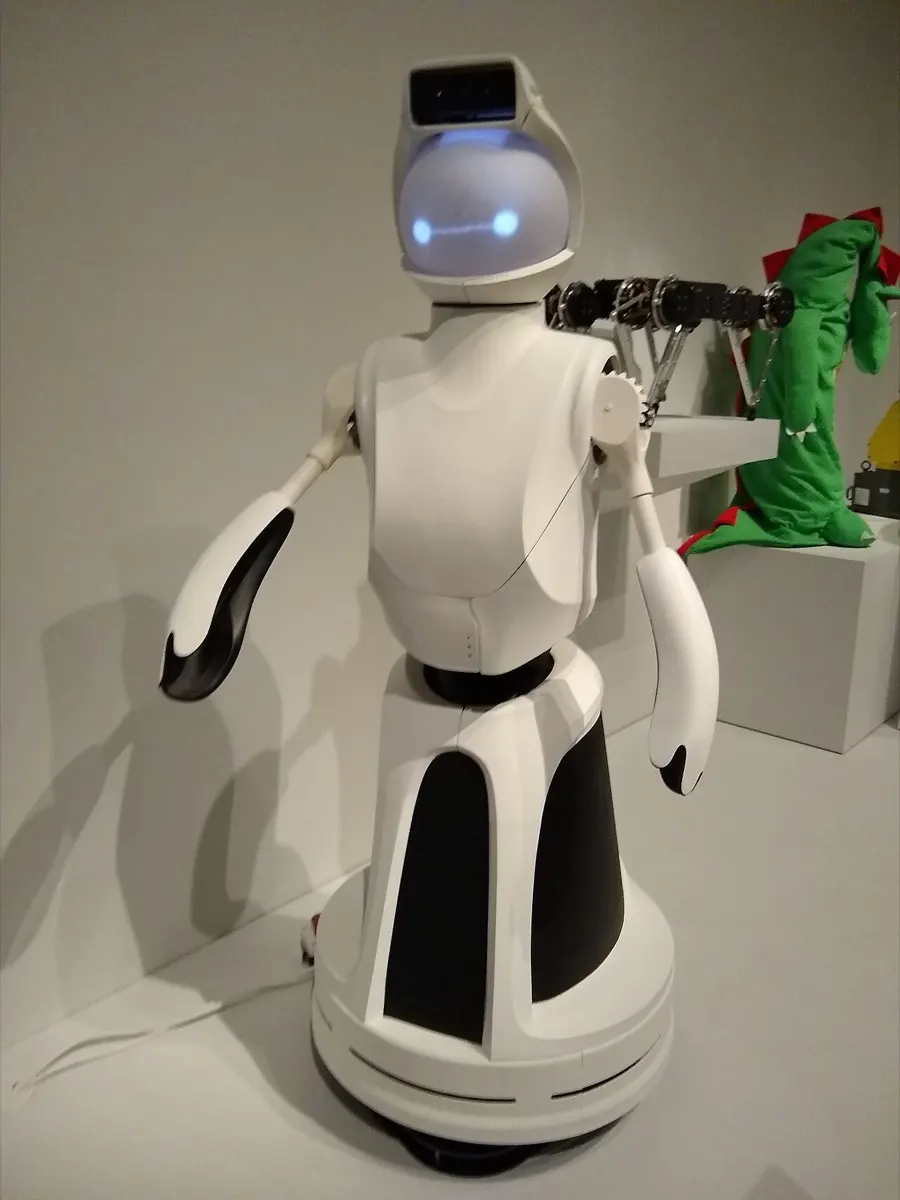
A low-cost, modular social-robot platform built so HRI researchers could share a common body. About ten units went to US labs. Its rear-projected spherical face and gesturing arms make it a research cousin to Pepper.
- Type
- Companion robot · Desk & social robots
- Maker
- University of Pennsylvania / Semio (USA)
- Released
- 2019
- Price
- Not for sale
- Status
- Not for sale (research)
- Best for
- Professionals & labs
- Programming
- Open source (hardware + software)
Price and shipping
Built under an NSF infrastructure grant and loaned to HRI research groups
Shipping: Not for sale. Research program units only. Not for sale.
Specifications
| Category | Companion robots · Desk & social robots |
|---|---|
| Released | 2019 |
| Country | USA |
| Availability | Not for sale (research) |
| Sales | 10 prototypes built and awarded to research teams by 2023 Oregon State University ↗ |
| Programmability | Open source (hardware + software) |
| Built-in autonomy | Reactive · Responds to its surroundings without a map, such as avoiding obstacles or following a person |
| LLM support | Possible via SDK · No built-in LLM. Its SDK lets software on a computer control it. |
| MuJoCo simulation | Maker URDF only · quori_description xacro in the project's quori_ros, no MuJoCo model found. quori_ros ↗ |
| NVIDIA Isaac simulation | Maker URDF only · quori_description xacro in the project's quori_ros, no Isaac asset found. quori_ros ↗ |
| Gazebo simulation | Maker URDF only · quori_ros has URDF but no Gazebo package, CMU student Gazebo sims were not found published. quori_ros ↗ |
| Best for | Professionals & labs |
| Vision sensors | Depth camera, Camera, Lidar |
| Actuators | Unknown |
| Audio | Microphone |
| Compute type | Proprietary / undisclosed |
| Remote control | Python from a laptop |
| Size | 1.35 m tall (resting), about 45–50 kg |
| Drive | Holonomic wheeled base, 2-arm upper body with projected face |
| Compute | Intel NUC running ROS |
| Vision | Depth camera (Orbbec Astra driver in the ROS stack) plus RGB camera |
| Lidar | Laser scanner in the mobile base (used for mapping and navigation) |
| Sensors | Mic array, projected face |
| Runtime | Not published |
| Speed | Up to 0.8 m/s (180°/s rotation) |
| SDK | ROS, open designs published by the project |
Common questions
How much does Quori cost?
Not for sale. Built under an NSF infrastructure grant and loaned to HRI research groups.
Can Quori be bought today?
No. It was never sold to the public.
Who makes Quori?
Quori is made by University of Pennsylvania / Semio (USA). It came out in 2019.
Can Quori be programmed?
Open source (hardware + software). ROS, open designs published by the project.
Does Quori have AI chat or LLM support?
Possible via SDK. No built-in LLM. Its SDK lets software on a computer control it.
Ratings & reviews
Ratings and reviews load on the live site.
Related guides
- Cutest Robots · the top 10 by press reviews
- Companion Robots for Loneliness · ten robots ranked by research evidence
Similar robots
 JiboJibo, Inc. (USA)Was $899 (2017)
 MoxieEmbodied, Inc. (USA)Was $1,499 (2020)
 PepperSoftBank Robotics / Aldebaran (Japan/France)Was ~$1,260 (¥198,000, Japan, 2015) + monthly plan
 ElliQIntuition Robotics (Israel/USA)$249 + $59/month
 Reachy MiniPollen Robotics / Hugging Face (France/USA)$399 – $499
 EMOLiving.ai (China)$279 (EMO) / $369 (EMO Go Home)
Image credits
- Image 1: source (CC BY-SA 4.0, Mary Mark Ockerbloom)