If you've read any of my other blog articles, you've probably seen that I created this site because originally I was looking to buy a robot, specifically a quadruped, a four-legged robot like a robot dog. I ended up gathering so much information that I thought it would be better to just create a website to share this with others. Things like robot specs, comparison charts, and even things like how simulators work. So that's what originally caused me to make this site, and now I've ended up with over 700 robots, growing almost every day.
But the ironic thing is that sometimes the more information you have, the harder it is to make the decision. In my case, I think one of the reasons I haven't been able to decide which robot to buy is because I have two or three goals that are conflicting, or at least hard to satisfy at once.
Conflicting goals
One of them is to have a cool robot, one that looks like something out of a science fiction movie, and also one that does some really dynamic tricks like flipping, standing on its hind legs and maybe even following me. Now for that goal, there is one robot that's really good. It's called the Unitree Go2, and there are a few versions. I can get the one that does the cool tricks like flipping for around $3,000 to $4,000 once you add shipping. It's called the Go2 Pro, and is pretty cool, but unfortunately it is a bit out of my budget. Originally I was aiming for $2,000, maybe $2,500 at most. But I could maybe find a used one for around $2,500, something along those lines.
The problem is my other goal is to have something that's fully programmable, which means it has an SDK, a software development kit. I can basically write code, or have Claude help me write code, to arbitrarily change the behavior. I have a bunch of ideas I mentioned before, like playing with my cat, finding objects or, who knows, trying to jump on my table. There's a variety of things I just want to experiment with and see what it can do, because I just think that's really fun.
Now the Go2 actually has that, but at a higher tier, the educational tier, which is unfortunately, I believe, over ten thousand dollars. That's way out of my budget, and even a used one would still be way out of my budget. There are supposedly some hacks that you can do on the Pro, or even on the lower-level Air. But there's no guarantee that's going to work, and it might brick it, so there's a lot of risk there. So that doesn't really work out too well.
If I was just focusing on the development aspect, I should be able to find some other robots. There's one called the XGO that has some reasonably good servos. It's pretty small, but it can even have an arm, and there's a bunch of versions. I could maybe spend a thousand dollars and change, $1,500, something like that, to get an okay CPU, a bunch of servos, three per leg, and maybe even a camera, so I can really program that. But it doesn't move very fast, first of all, and it can't really balance on its back legs. It can't flip, although it could do some pretty cool behavior, so it could probably search my house for stuff. But it doesn't really look very impressive, and it just doesn't have the same impact.
None of these robots look cute. If you wanted a cute robot, you'd want something like the Sony aibo, which I've always wanted for many years. But the big problem with that is it moves very slowly and it doesn't do jumps. It isn't about the mechanics; it's more about the behavior and the look, and it's really great for that. So I think the cuteness factor for me is lower priority, but it is a nice thing to have.
So the bottom line is I can't really fulfill all these things at once. As a result, after roughly two weeks of searching, I just haven't found a bot I'm really happy with.
Imports and the FX Navi
One of the reasons that it's so difficult is that it turns out the majority of robot dogs are created in China, which is okay, I have no problem with that. But the trick there is if you buy something from China, especially technology, there are tariffs, and that could cost roughly 20–30% with other fees. You could have something that would be roughly $1,000 in China, including the conversion rate, and it might even reach $2,000 by the time you get it here. And it might take weeks and weeks, I don't know, maybe a month or two or more. I haven't actually done that, but the research shows that I'm going to spend a lot more and it's going to take a lot more time. Another problem is service. If something breaks, can you get parts? Not necessarily, and you may have to send it to China.
Now there is one company, Faraday Future, which is a pretty interesting company, and they have a few robots that are kind of nice. One of them is called the FX Navi, which I was looking into. It has some pretty good servos and pretty good movement. Although it can't flip, it can do a lot. The catch there doesn't have a lot of onboard CPU, so you would have to basically put in your phone to add a camera and add CPU, and then you can do a lot. Without your phone it's somewhat limited, though you can still control it. It also doesn't really have a head by default. You kind of have to make one, or I think they sell one, but it seemed like it was out of stock. So there are some questions about that, because I haven't seen a lot of reviews. But I have been interacting with the company, and they have had great customer service so far, giving me a lot of information about it.
The problem is, although it looks kind of cool, it's nothing as good as a Unitree Go2. It just doesn't compare. It goes slower and it doesn't flip. The programmability would be pretty good, and maybe I can get it for around $2,000 to $2,400, something in that ballpark, which is roughly within budget. But I don't know, it just doesn't feel like it's the right thing, so I'm still thinking about it.
A plan with Claude
As I was doing all this, of course, I'm using Claude for a lot of my research. I think that's fine, because it's ultimately about gathering information, putting it in one place and comparing things, which it turns out Claude is really good at. I do need to do a lot of checks and validations on my own, and different queries, to make sure the information is valid. Much of the information on the site I do read through myself, make edits and look for correctness. But it's still a great tool for this.
So what I decided to do is, just on a whim, start asking Claude a few queries: hey, can you create a robot for me that's a little bit like some of these expensive professional ones, but also like others that look cute, and others that I've seen around here, with some of my own ideas thrown in? So basically taking influence from a lot of areas. One of the big requirements is that I can program it, and that it's mechanically strong and versatile enough that it can do flips, which again is pretty rare.
After a few hours of querying back and forth, I actually ended up with a plan. The plan is to the details of to build a quadruped robot that again was loosely inspired by a bunch of other ones. I have a parts list and a series of initial steps. It's not the whole plan, but it's the beginning of the plan.
Now this sounds great. I do have a background of electrical engineering, and even though I'm not that good with mechanical engineering, I think I could figure it out. And of course on the programming side, I know how to code, and Claude knows how to help me code, so I could figure that out.
Servos and the total cost
But one of the biggest challenges is that in order to do some of these serious tricks like flipping, which again is the most challenging one, you really need powerful servos. That means they can handle a lot of torque, they're fast, and there's a whole list of other things. Again, I'm not that familiar with servos and motors; I'm still learning about them. But to get a good servo, you might end up paying around $200 to $250 each. And keep in mind, in order to have a design where you can balance well, you generally need three servos per leg. That's kind of the minimum. You can kind of get by with two, but there are limitations, because that limits the side-to-side balance and getting up when you fall. So the default is to have what they call 12 DOF, which is 12 degrees of freedom, which is of course three servos per leg. So if you take roughly $200 to $250 a servo and multiply that by 12, plus a couple of spares, you're looking at around $2,500, and that's just for the servos.
To actually make it strong enough so that it can do flips without crashing, you need to have a strong enough body, you need to have power, and you need to have protection so things don't get overloaded, et cetera. Oh, and by the way, I also had to ask for tools. For example, I don't have a 3D printer, or even things like a meter, and there's a hacksaw for cutting parts, a heat gun, and all these other tools that I just don't have. So after all this, when I added it up, you'd be very surprised: the total cost is around seven thousand dollars. Which is crazy, right? Way more than planning on spending.
Now the catch is, if I did that, I would be spending the money over time. It wouldn't be like buying it all at once. And I would be a little bit more okay with spending the money, because it'd be a huge educational benefit. I would learn a lot, and if I got it to work, or even if it failed, I would get a lot of content I can create, frankly, in terms of YouTube, blog articles, you name it. And if I got it to work, who knows, maybe someday I would be able to get hired at a robotics place a few years from now. I like my job now, but that would definitely be something cool that I could do. So I think if I spent that $7K over the next year or so, it might actually be worth it.
A first leg
Still, I want to see what the first step is. So I'm iterating back and forth talking to Claude, and Claude is checking which parts are available, how long they take, where I can source them, et cetera. As I mentioned, servos are one of the most expensive parts, but there are also the details of the servos. One of the factors is, well, they definitely heat up, but how hot do they get as a result of doing certain actions? If they go very fast or take a lot of torque, how much do they heat up? Because if they overheat, they would get burned out, or something bad would happen. There are some specs in the spec sheet, but it doesn't have everything.
So to know if those servos would even work, and potentially allow things like jumps, where there's a lot of quick, instantaneous torque, I would need to run tests on that. The good news is I can buy one or maybe two servos, because there are two different types of servos. A smaller one handles two of the joints on each leg, the hip and the side-to-side motion, and a bigger one handles the knee. And I could do some tests, checking the temperature and trying a bunch of different things. The idea is that I would have a kind of rack where I'm hanging a single leg from it. Eventually I would even print the leg parts, which I would probably do with a 3D printer, or I could find another company. But the point is I would work on the first two servos, get some details, and make sure they match what I have. Then I'd get a third servo, make the first leg, and get that to kind of jump or hop. That would actually prove a lot.
I guess the bad news is that just to get to that point is probably around $2,000 once you count the 3D printer, which is pretty expensive. The servos are only part of that, though. A lot of it is batteries, tools and test gear that I would be reusing for the rest of the robot. It's still a lot of cost.
Simulation in MuJoCo
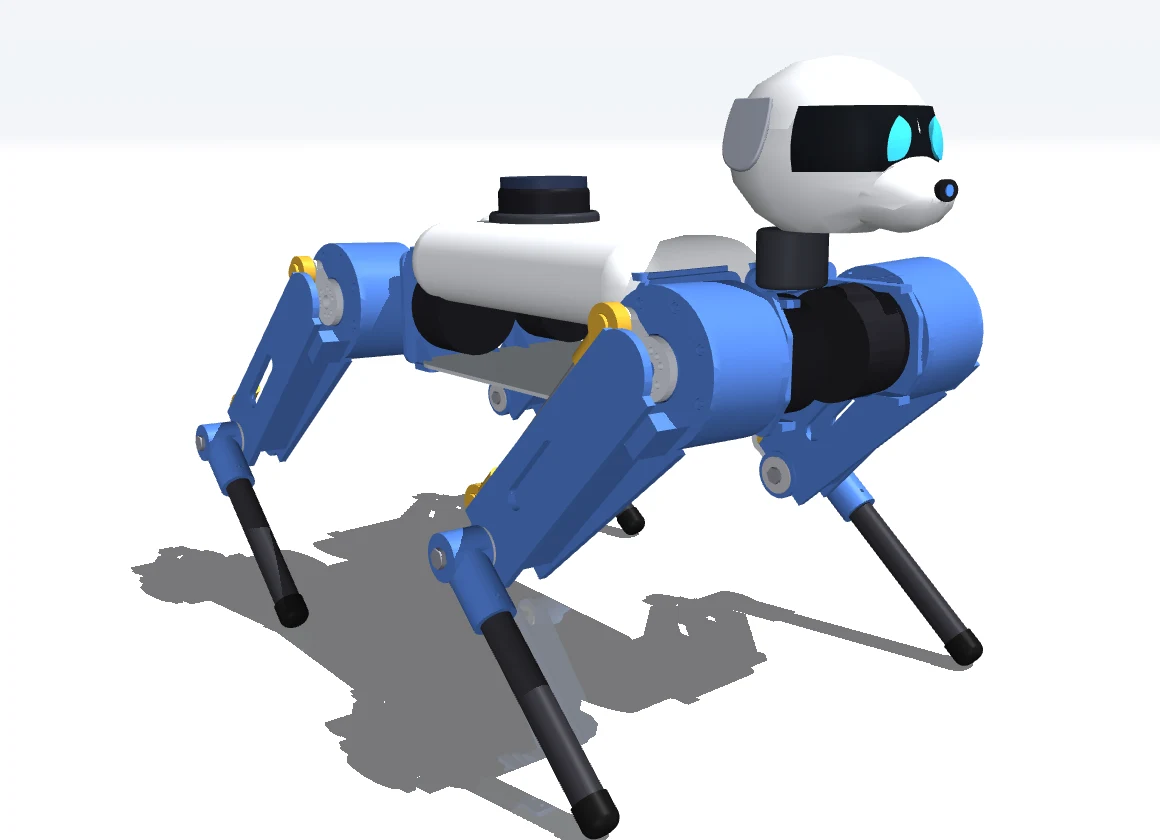
But one of the good things is that in creating this site, I did a lot of research in different areas and learned a lot of different things. One of them is called MuJoCo, which is one of the most widely used simulators in robotics research. The good news is I was able to get Claude to create a model for me that I can import into MuJoCo and simulate. So I could actually see it jumping, see what it looks like, see it walking, different types of trots at different speeds. You get a rough idea of the max speed, how the jump looks, a backflip, that kind of thing. And that's cool. Of course it isn't guaranteed to be 100% accurate, and there are things that it won't capture, but it looks pretty cool and I think it's reasonably accurate, so I can have some level of confidence in it.
Once I do some of these tests, like the heat, and determine some of the performance of these servos live, I can actually plug that back into the simulator, run the simulator again and then look at the big picture. If that first leg works, I can move on to making more legs and eventually buying the CPU. There are some ideas there, whether I use a Raspberry Pi or get something more advanced, but that's something I can actually decide later. That's the good news there.
A long-term project
Anyway, this is going to be a long-term project no matter what. Even if it works well, it could easily take three to six months, maybe even a year, depending on how many hours I spend. This is just evening and weekend time, which is limited, so it would be little by little, baby steps.
These are my ideas so far, and hopefully in a few weeks I can give an update. Thanks for reading.