Overview
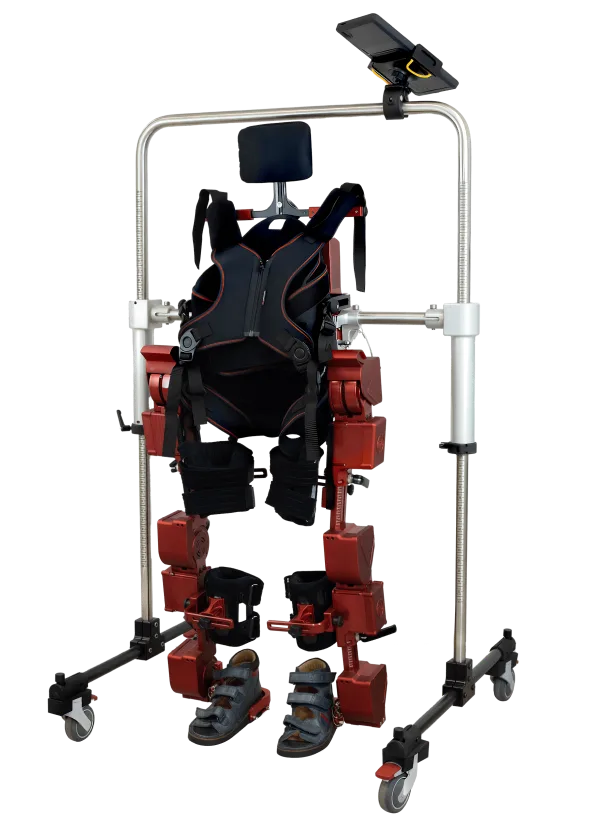
ATLAS 2030 is the first pediatric gait exoskeleton to reach the European market, built by Marsi Bionics out of research at the Spanish National Research Council (CSIC). It is a trunk-to-feet orthosis with eight powered joints whose variable-stiffness actuators mimic muscle, and it is sized for children aged 3 to 14 with cerebral palsy, spinal muscular atrophy and other neuromuscular diseases, with a frame that is adjusted as the child grows. The child walks inside a wheeled auxiliary frame with an optional head support, so no crutches are involved, and therapists switch between a passive mode that moves the legs and an active mode that trains the child's own strength. It received a CE mark in May 2021 and is used in more than 40 Spanish hospitals, rehabilitation centres and foundations, with centres in France, Mexico, Poland, Germany, Italy and Ireland, through distributors such as Rehagirona, Medimex and Skyfi. There is no FDA clearance. It is a clinic device only, sold or rented on quotation, and the smaller walker-style Trexo Theo is the other pediatric option in this guide.
Specifications
| Category | Exoskeletons & exosuits · Medical & rehabilitation |
|---|---|
| Released | 2021 |
| Country | Spain |
| Availability | Available |
| Sales | Used in more than 40 facilities in Spain plus about 17 in France, Mexico, Poland, Germany, Italy and Ireland. (estimate) Marsi Bionics centre map ↗ |
| Programmability | No SDK, app / visual programming only |
| Built-in autonomy | Reactive · Responds to its surroundings without a map, such as avoiding obstacles or following a person |
| LLM support | None · No voice assistant or LLM. |
| Best for | Ages 3–14 (maker rating) |
| Vision sensors | No vision sensors |
| Actuators | Brushless / direct-drive motors |
| Audio | No audio |
| Compute type | Proprietary / undisclosed |
| Control | App-adjusted |
| Weight | 14 kg |
| Assistance | Eight active joints at the hips, knees and ankles move a child's legs through a gait pattern in a passive mode, or let the child drive the motion with their own strength in an active mode. It walks forwards and backwards inside a wheeled support frame. |
| Joints | Hips, knees & ankles |
| Battery & runtime | Battery capacity and runtime are not published. Extra batteries are included. |
| Operation | A therapist sets the gait and stiffness parameters on a tablet and the device interprets the child's movement intention. No chest control is needed and fitting takes about 5 minutes. |
| Sensors | Joint position and torque sensing in the variable-stiffness actuators for intention detection (details not published) |
| Compute | Not published |
| SDK | None |
Ratings & reviews
Ratings and reviews load on the live site.
Similar robots
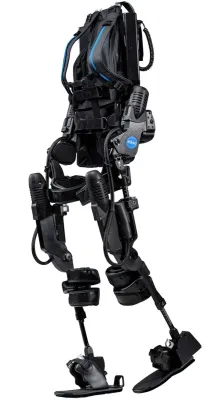 EksoNREkso Bionics, a Wandercraft company (USA)Quote only
 Ekso Indego PersonalEkso Bionics, a Wandercraft company (USA)Quote only
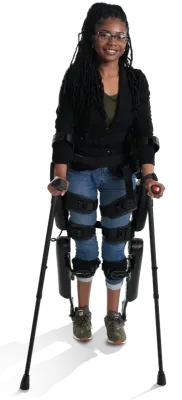 ReWalk 7 Personal ExoskeletonLifeward (USA / Israel)Quote only
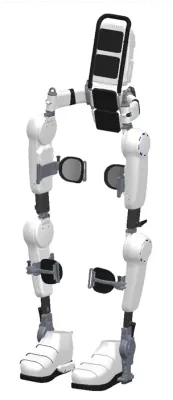 Medical HAL Lower Limb TypeCyberdyne (Japan)Quote only
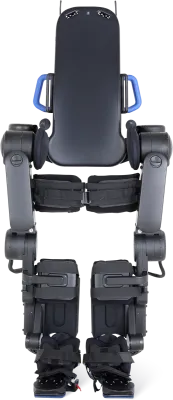 Atalante XWandercraft (France)Quote only
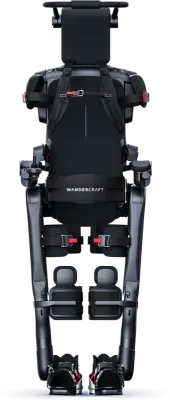 EveWandercraft (France)Quote only
Image credits
- Image 1: source (official product image)