Overview
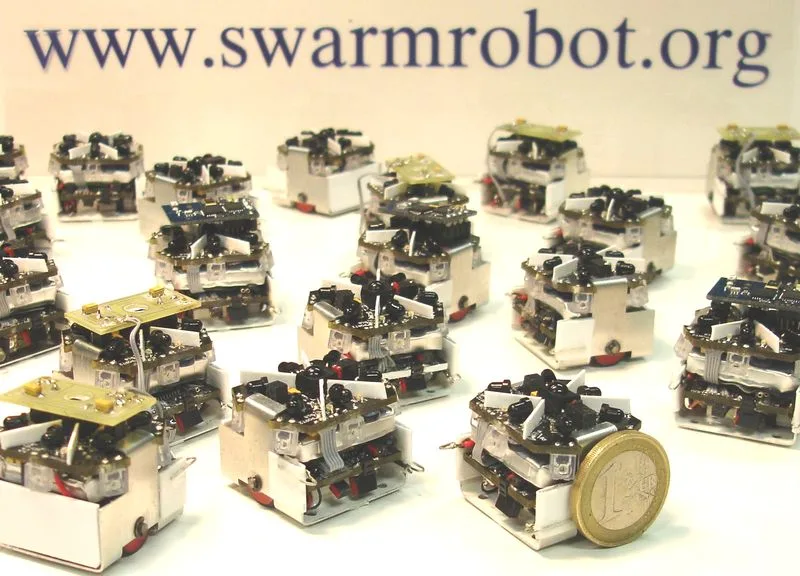
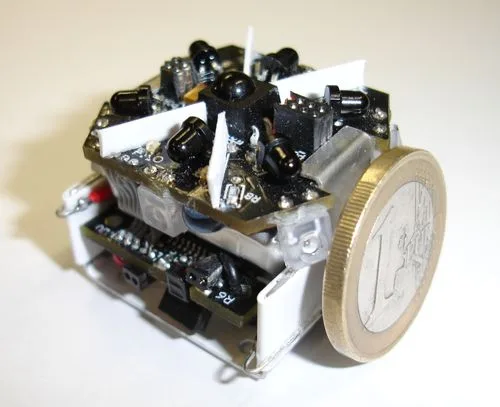
An open-hardware micro-robot from the I-Swarm era, designed by Sergey Kornienko and colleagues at the University of Stuttgart so that a lab could build a swarm of 100 or more robots for around 100 euro each. Robots work together without any central computer. Each one sends and receives short infrared messages on six channels around its body, reaching about 15 to 30 cm at over 1,000 bits per second, and the channel a message arrives on tells it which side the sender is on. The same infrared parts double as distance sensors, so swarm behaviors such as aggregation, collective perception and docking for recharge run entirely from local contact between neighbors. The catch is that it was never sold, building one means hand-assembling small SMD boards from a parts list that is now two decades old, and the project has been hosted independently since the University of Stuttgart stopped hosting it in 2012.
Specifications
| Category | Wheeled rovers · Research mobile manipulators & platforms |
|---|---|
| Released | 2005 |
| Country | Germany |
| Availability | Not for sale (research) |
| Programmability | Open source (hardware + software) |
| Built-in autonomy | Reactive · Responds to its surroundings without a map, such as avoiding obstacles or following a person |
| LLM support | None · No LLM features. Each robot runs a few kilobytes of C on an 8-bit microcontroller with no network link to a computer. |
| MuJoCo simulation | None found · Nothing found. |
| NVIDIA Isaac simulation | None found · Nothing found. |
| Gazebo simulation | None found · Nothing found. The project ships its own simulator built on the open-source Breve 3D engine (scripts in the Steve language) with models of Jasmine III and its proximity and distance sensors. |
| Best for | Professionals & labs |
| Vision sensors | No vision sensors |
| Actuators | DC / gear motors |
| Audio | No audio |
| Compute type | Arduino / ESP32 / microcontroller |
| Remote control | Via SSH / web / bridge |
| Size | About 26 × 26 × 26 mm, a stack of circuit boards on a small chassis |
| Drive | Two GM15 geared DC motors, differential drive |
| Compute | ATmega168 on the main board (16 KB flash) plus an ATmega88 on the motor board, linked by a TWI (I2C) bus |
| Vision | None |
| Lidar | None |
| Sensors | Six infrared channels around the body used both for obstacle and distance sensing (over 150 mm) and for robot-to-robot messages, surface-shape and color sensing per the arXiv paper, battery level sensor. Extension boards add odometry, light-gradient and color sensing, ZigBee radio and a docking/charging station |
| Runtime | About 1 to 2 hours on a 250 mAh LiPo cell (about 200 to 220 mA in full operation) |
| Speed | Over 50 cm/s maximum (arXiv paper) |
| SDK | Open-source C firmware for AVR (compact BIOS with motion, collision avoidance, communication and perception modules) and a Breve-based simulator, all downloadable from swarmrobot.org under the GNU GPL |
Ratings & reviews
Ratings and reviews load on the live site.
Similar robots
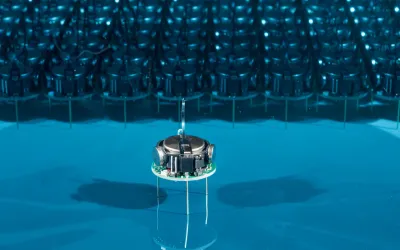 KilobotHarvard Self-Organizing Systems Research Group / K-Team (USA / Switzerland)$1,320 (10-pack)
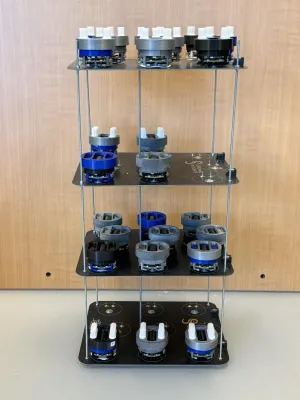 PogobotSorbonne Université ISIR / ESPCI Paris-PSL (France)Not for sale
 DropletCorrell Robotics Lab, University of Colorado Boulder (USA)Not for sale
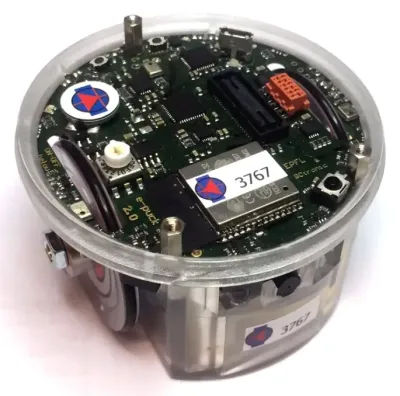 e-puck / e-puck2EPFL / GCtronic (Switzerland)$1,020
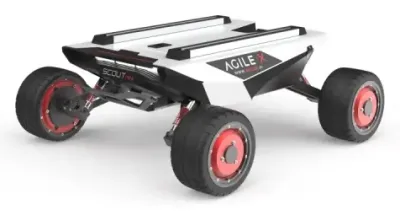 AgileX Scout MiniAgileX Robotics (China)$5,895.95 (Trossen)
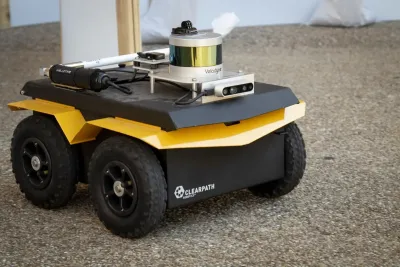 Clearpath JackalClearpath Robotics (Canada, part of Rockwell Automation)Quote (~$20,000+, est.)