Overview
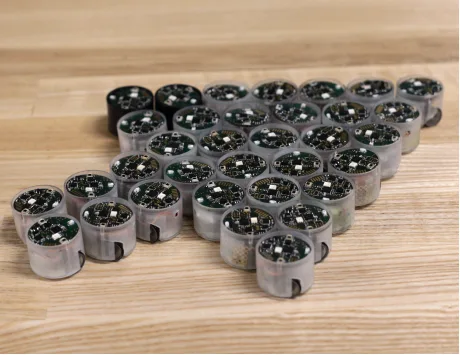
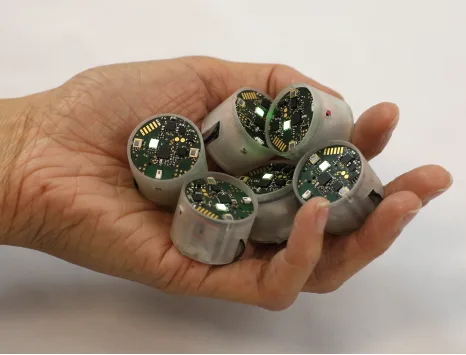
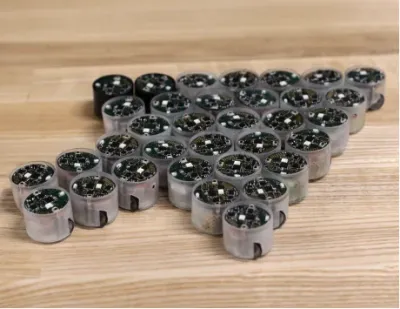
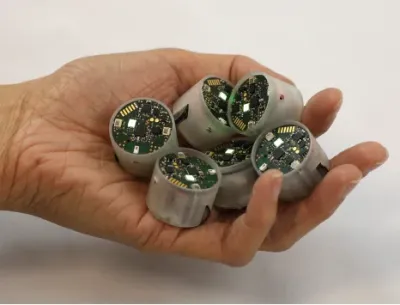
Coin-sized wheeled robots built at Stanford's Shape Lab with Inria to act as a moving tabletop display, where each robot is a physical pixel that can also be grabbed and moved by hand. The robots do not talk to each other at all, since a central computer is in charge of the whole group. Each robot decodes its own position from gray-code patterns flashed by a 3,000 Hz projector above the table and reports it back by radio. The computer runs the application, plans collision-free paths for every robot (HRVO) and sends each one its next waypoint 60 times a second, with each USB radio receiver serving 10 robots. The catch is that it only works inside the area lit by a special high-speed DLP projector, the robots must turn before moving since the drive is not holonomic, and every robot has to be built from the published files.
Specifications
| Category | Wheeled rovers · Research mobile manipulators & platforms |
|---|---|
| Released | 2016 |
| Country | USA, France |
| Availability | Not for sale (research) |
| Programmability | Open source (hardware + software) |
| Built-in autonomy | None / scripted · Moves only when controlled, or plays preset motions |
| LLM support | Possible via SDK · No LLM features. Applications are openFrameworks (C++) or Processing programs on a computer, which could in principle call an LLM to choose where the robots go. |
| MuJoCo simulation | None found · Nothing found. |
| NVIDIA Isaac simulation | None found · Nothing found. |
| Gazebo simulation | None found · Nothing found. The ZooidManager software has its own simulation layer that plans paths before sending goals to the real robots, but no Gazebo, ARGoS or Webots model was found. |
| Best for | Professionals & labs |
| Vision sensors | No vision sensors |
| Actuators | DC / gear motors |
| Audio | No audio |
| Compute type | Arduino / ESP32 / microcontroller |
| Remote control | Via SSH / web / bridge |
| Size | 26 mm diameter, 21 mm tall, about 12 g |
| Drive | Two micro gear motors (FA-GM6-3V-25) placed off-axis to save space, differential drive with caster wheels |
| Compute | STM32F051C8 (48 MHz Arm Cortex-M0) |
| Vision | None (two photodiodes on top read patterns from an overhead projector to find the robot's position) |
| Lidar | None |
| Sensors | Two photodiodes for projector-based position tracking (about 73 updates per second, about 1.1 mm resolution over a 1 × 0.63 m area), capacitive touch sensing around the body, RGB LED, nRF24L01+ 2.4 GHz radio |
| Runtime | About 1 hour of continuous moving on a 100 mAh LiPo, longer in normal use |
| Speed | About 74 cm/s maximum, about 44 cm/s in typical use |
| SDK | Open-source ZooidManager (openFrameworks, C++) with a prebuilt macOS app, client APIs for openFrameworks and Processing, robot and receiver firmware for the STM32, example apps (shapes, keyframes, scatterplot, stop motion) |
Ratings & reviews
Ratings and reviews load on the live site.
Similar robots
 CelluloEPFL CHILI Lab (Switzerland)Not for sale
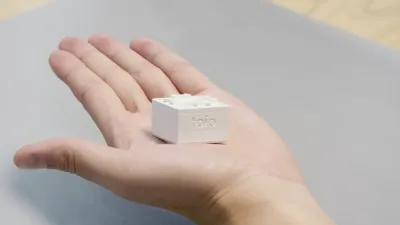 toio Core CubeSony Interactive Entertainment (Japan)$48
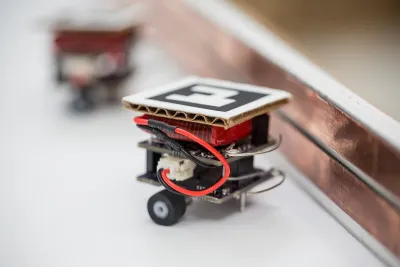 GRITSbot / GRITSbot X (Robotarium)Georgia Tech GRITS Lab / Robotarium (USA)Not for sale
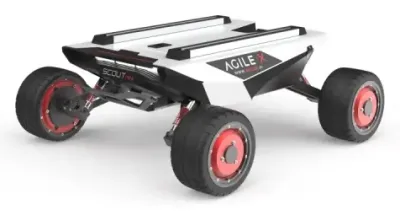 AgileX Scout MiniAgileX Robotics (China)$5,895.95 (Trossen)
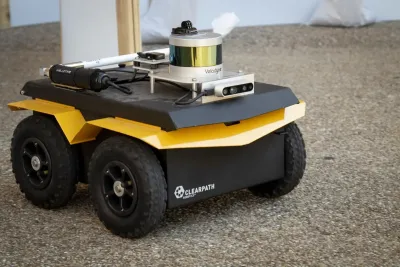 Clearpath JackalClearpath Robotics (Canada, part of Rockwell Automation)Quote (~$20,000+, est.)
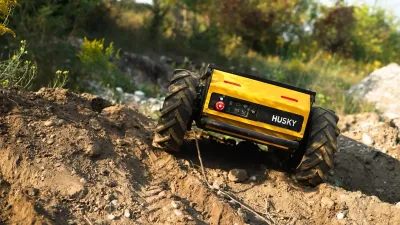 Clearpath Husky (A200 / A300)Clearpath Robotics (Canada, part of Rockwell Automation)Quote (~$30,000+, est.)