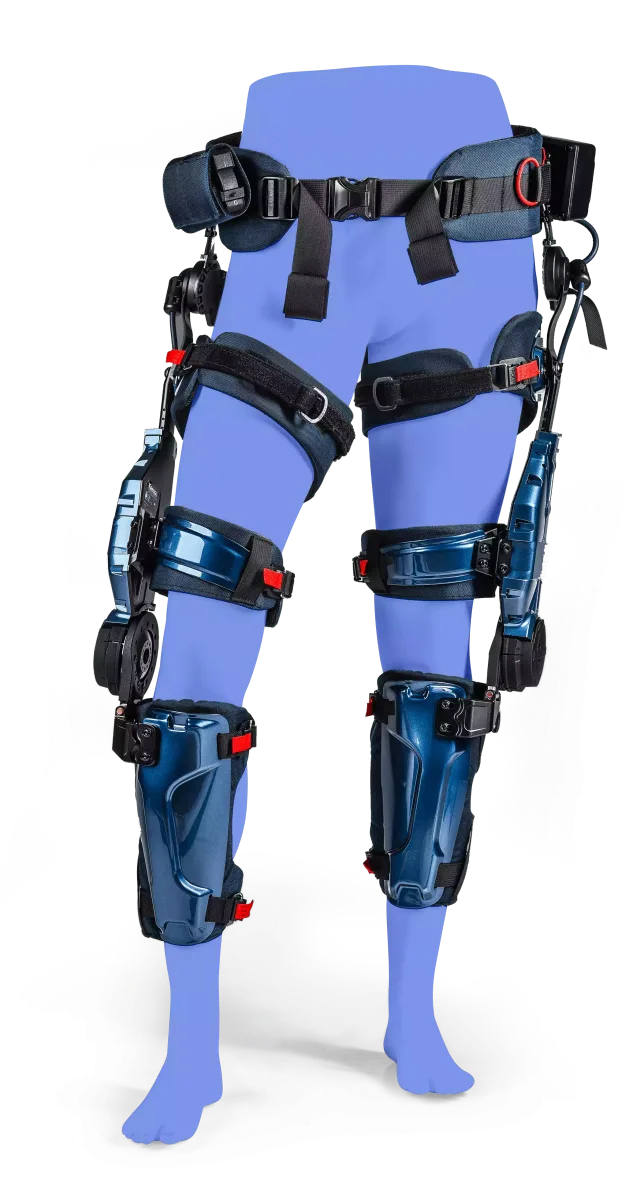
Overview
Keeogo is a powered knee orthosis from Quebec's B-Temia, marketed as a 'dermoskeleton' because it braces and powers the knees while leaving the wearer in charge of balance and direction. It suits people who can already walk but tire quickly or have weak or painful knees, and the motors push through the movements the wearer begins, so it is a walking aid rather than a device for paralysis. B-Temia is one of the few makers that sells to individuals, through certified clinical partners in Canada that run a questionnaire, an evaluation and a 3-week home trial before sale or rental, with distributors in the UK, France, Mexico and Asia. It carries a CE mark for personal use, and B-Temia states FDA and CE approval for professional rehabilitation use (the FDA 510(k) is reported as September 2020 for stroke rehabilitation under supervision, unconfirmed), but Keeogo is not available for commercial sale in the US and is used there only in research. Users need a waist of 26–42 in and a height of at least 155 cm, the battery lasts 1 to 4 hours, and the device weight is not published. The knee-only design is the same technology Lockheed Martin licensed for its ONYX soldier exoskeleton.
Specifications
| Category | Exoskeletons & exosuits · Medical & rehabilitation |
|---|---|
| Released | 2015 |
| Country | Canada |
| Availability | Available |
| Programmability | No SDK, app / visual programming only |
| Built-in autonomy | Reactive · Responds to its surroundings without a map, such as avoiding obstacles or following a person |
| LLM support | None · No voice assistant or LLM. |
| Best for | Ages 18+ (estimated) |
| Vision sensors | No vision sensors |
| Actuators | Brushless / direct-drive motors |
| Audio | No audio |
| Compute type | Proprietary / undisclosed |
| Control | App-adjusted |
| Weight | Not published |
| Assistance | Motors at each knee add torque to the wearer's own walking, stair climbing and sit-to-stand, with the device following the motion the wearer starts rather than driving a fixed gait. It is for people who can still walk but lack strength, endurance or knee stability (stroke, MS, Parkinson's, incomplete SCI, knee osteoarthritis, myositis, muscular dystrophy), not for complete paralysis. |
| Joints | Knees |
| Battery & runtime | Removable battery lasting 1 to 4 hours depending on use, 1.5 h recharge. |
| Operation | A manual control unit on the device switches assist levels, and a clinician sets the parameters in configuration software during fitting. |
| Sensors | Hip and knee position sensors and inertial sensing that interpret the wearer's intended movement |
| Compute | Not published |
| SDK | None |
Ratings & reviews
Ratings and reviews load on the live site.
Similar robots
 EksoNREkso Bionics, a Wandercraft company (USA)Quote only
 Ekso Indego PersonalEkso Bionics, a Wandercraft company (USA)Quote only
 ReWalk 7 Personal ExoskeletonLifeward (USA / Israel)Quote only
 Medical HAL Lower Limb TypeCyberdyne (Japan)Quote only
 Atalante XWandercraft (France)Quote only
 EveWandercraft (France)Quote only
Image credits
- Image 1: source (official product image)