Overview
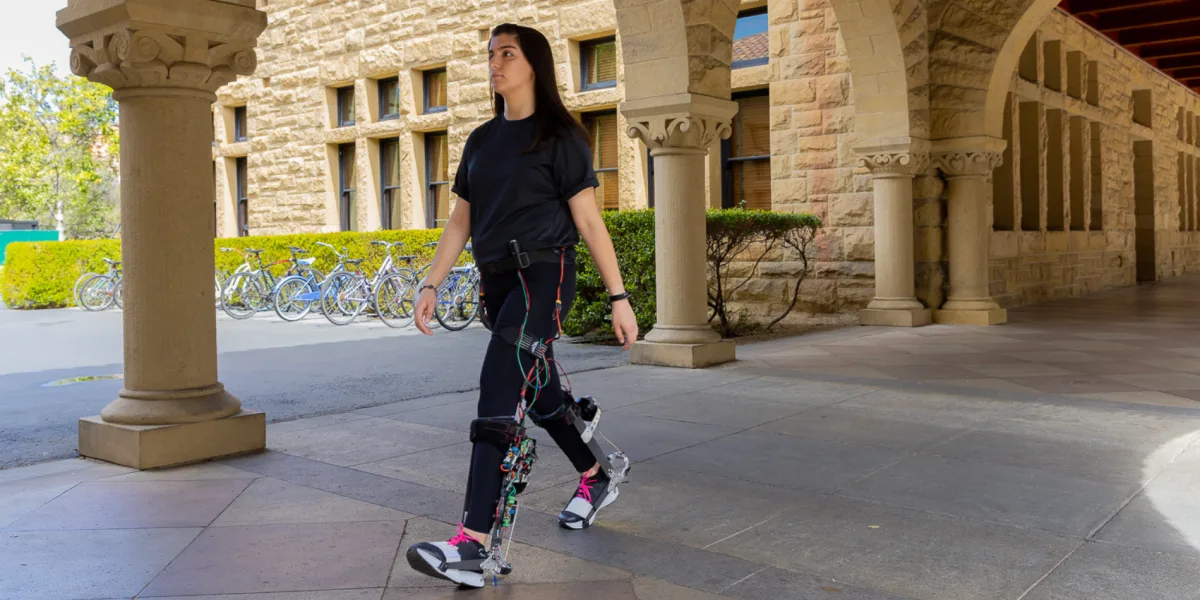
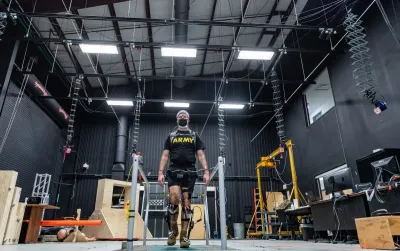
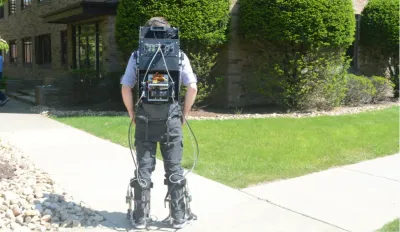
The Stanford exoskeleton boot is a research prototype from Steve Collins' Biomechatronics Lab, an untethered ankle exoskeleton that personalizes its own assistance while the wearer walks in everyday settings. Published in Nature on 2022-10-12 (Slade et al.), it used a machine-learning model trained on years of tethered emulator experiments to tune each person's assist within about an hour, giving 9% faster walking and 17% less energy per distance in 10 participants. The hardware is simple for its class, a CubeMars AK80-9 motor, a Raspberry Pi 4B and a small battery in a 1.2 kg unit per ankle, and the design files are published under CC BY 4.0. It was never sold, and no spin-off product based on it has been announced (unconfirmed). Commercial relatives include the Dephy ExoBoot and consumer Sidekick, while its control research came from Caplex-style emulators.
Specifications
| Category | Exoskeletons & exosuits · Full-body, military & research |
|---|---|
| Released | 2022 |
| Country | USA |
| Availability | Not for sale (research) |
| Programmability | Open source (hardware + software) |
| Built-in autonomy | Reactive · Responds to its surroundings without a map, such as avoiding obstacles or following a person |
| LLM support | None · No voice assistant or LLM. |
| Vision sensors | No vision sensors |
| Actuators | Brushless / direct-drive motors |
| Audio | No audio |
| Compute type | Other ARM chip |
| Control | SDK or research mode |
| Weight | 1.2 kg per ankle (battery 0.3 kg) |
| Assistance | A brushless motor at the heel pulls on the boot during push-off with up to 54 Nm at 1.5 m/s. In outdoor tests it raised walking speed by 9% and cut energy per distance by 17%, which Stanford likened to taking off a 30 lb (14 kg) backpack. |
| Joints | Ankles |
| Battery & runtime | 24 V, 1,300 mAh lithium-polymer battery (0.3 kg), at least 30 minutes of walking per charge. |
| Operation | No wearer controls. A machine-learning model trained on years of emulator data adjusts the assistance pattern to each person within about an hour of normal walking. |
| Speed | Tested at self-selected walking speeds and 1.5 m/s on a treadmill |
| Sensors | Ankle rotary encoder, pressure-sensing insole, strain-gauge torque sensor on the heel spur. |
| Compute | Raspberry Pi 4B running control and optimization at 200 Hz |
| SDK | CAD files, bill of materials and Python optimization code published as Nature supplementary data |
Ratings & reviews
Ratings and reviews load on the live site.
Similar robots
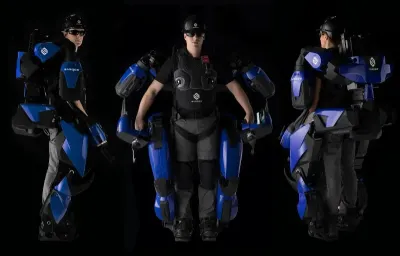 Sarcos Guardian XOSarcos Robotics, now Palladyne AI (USA)$100,000 per year (rental)
 Lockheed Martin ONYXLockheed Martin (USA)Not sold
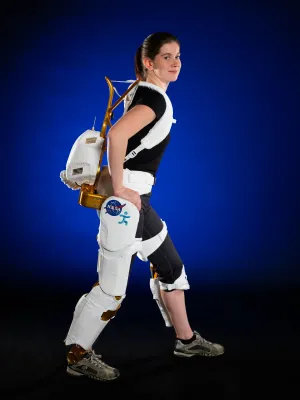 NASA X1 exoskeletonNASA Johnson Space Center with IHMC (USA)Not sold
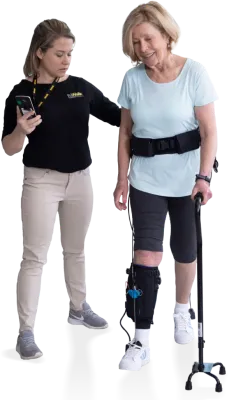 Harvard Soft Exosuit (and ReStore)Harvard Wyss Institute and Lifeward (USA)Quote only
 Dephy ExoBootDephy (USA)Was quote only
 Humotech CaplexHumotech (USA)Quote only
Image credits
- Image 1: source (press image, photo by Kurt Hickman, Stanford)