DOF in brief
A robot's degrees of freedom (DOF) are the separate ways its joints can move. In a robot dog each motor drives one joint, so the leg DOF count is the number of leg motors. An 8 DOF dog has two motors per leg and a 12 DOF dog has three. Head and tail servos add to the total but not to the legs.
The two motors every robot dog has are the hip pitch and the knee. Together they swing the leg forward and back and shorten or lengthen it, so each foot moves in a flat plane alongside the body. The third motor, the hip abduction or side-swing motor, tilts the whole leg outward and inward. It lets a foot step to the side, out of that plane.
The third motor costs weight, money and power. Each one is a full actuator with its own driver, and in a four-legged robot dog there are four hip abduction motors. The question is which movements require or benefit from them.
Robot dogs by motors per leg
Nearly every robot dog larger than a desk kit has three motors per leg, from the Unitree Go2 to Spot. Among small servo kits, two per leg is common, and a few research robots built for speed and jumping also use two.
| Motors per leg | Leg DOF | Examples |
|---|---|---|
| 1 | 4 | Petoi Quaddle, Scout II |
| 2 | 8 | Petoi Bittle, Nybble Q, PuppyPi, MechDog, PiDog, Sesame, Stanford Doggo, Minitaur, Solo 8 |
| 3 | 12 | Unitree Go2, Spot, ANYmal D, MIT Mini Cheetah, Pupper v3, Mini Pupper 2, CyberDog 2, Jueying Lite3 and almost all others |
| 4 | 16 | BigDog (hydraulic) |
Some robots have more motors in total for parts other than the legs. Sony aibo has 22 axes, with three per leg plus the head, neck, mouth, waist, ears and tail, and PiDog has 12 servos with only 8 in its legs.
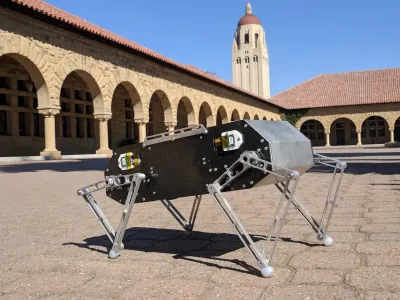 Stanford DoggoNot for sale
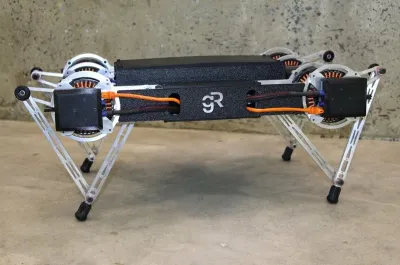 MinitaurWas ~$10,000 (quote)
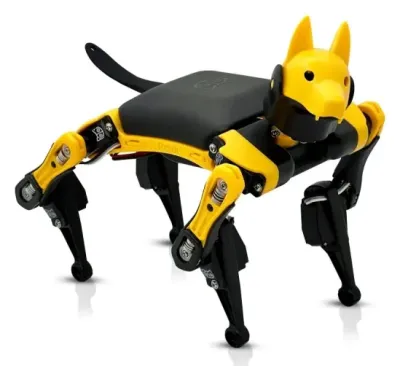 Bittle / Bittle X$289 – $469
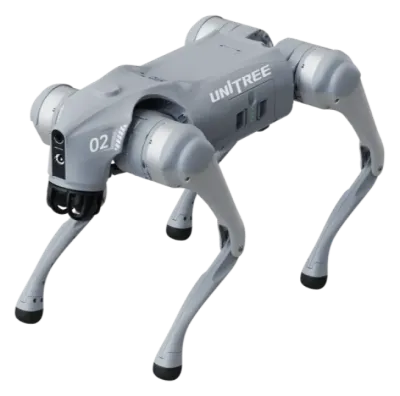 Go2 Air / Pro / X$1,600 / $2,800 / $4,500
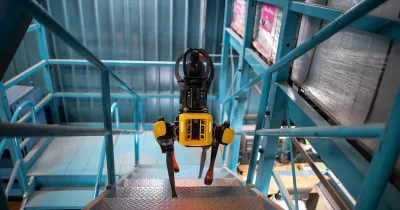 Spot~$75,000+
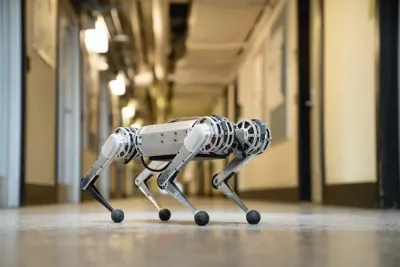 MIT Mini CheetahNot for sale
Simulation test
To measure the difference, one robot dog design was built twice in the MuJoCo simulator. The 8 DOF version weighs 7.5 kg. The 12 DOF version adds one side-swing motor at each hip and weighs 8.7 kg. Both use the same body, legs, battery and motor model, with the torque limits, heat and battery sag of a real 14 N·m brushless actuator.
Each version got the same training. Walking used one reinforcement learning policy per version, trained for 100 million steps on a laptop GPU and commanded to walk forward, sideways and diagonally and to spin. Getting up used a second learned policy per version. Jumps, flips and the other tricks used searched keyframe movements with the same number of search rounds for each version.
Results
| Movement | 8 DOF | 12 DOF | Better |
|---|---|---|---|
| Walk at 1.0 m/s | 0.96 m/s, 138 W | 0.96 m/s, 149 W | 8 DOF (power) |
| Run at 2.0 m/s | 1.89 m/s, 271 W | 1.97 m/s, 327 W | 12 DOF (speed), 8 DOF (power) |
| Standing still | 23 W | 38 W | 8 DOF |
| Crab walk at 0.4 m/s | 0.06 m/s | 0.35 m/s | 12 DOF |
| Diagonal walk | 0.03 m/s sideways | 0.27 m/s sideways | 12 DOF |
| Spin at 2.5 rad/s | 2.26 rad/s, 135 W | 2.46 rad/s, 102 W | 12 DOF |
| Side shove while walking | falls at 160 N | stays up to 200 N | 12 DOF |
| Body sway, feet planted | no side shift, 5° twist | 4 cm shift, 10° twist | 12 DOF |
| Shake a paw | holds 3 s, 28 W | holds 3 s, 71 W | 8 DOF (power) |
| Hind-leg stand | 10 s, 48 W | 10 s, 57 W | 8 DOF (power) |
| Vertical leap | 14.5 cm, 493 J | 13.5 cm, 607 J | 8 DOF |
| Running leap | 31.7 cm | 32.9 cm | 12 DOF (small margin) |
| Backflip | lands | reaches 174° | 8 DOF |
| Side flip | reaches 42° | reaches 68° | Neither lands it |
| Get up after a fall | 2.3 s | 0.9 – 1.1 s | 12 DOF |
Power is the average drawn from the battery over the movement, and energy is the total for the whole clip. Leap heights are the air under all four feet.
Sideways motion
The clearest difference is sideways motion. Asked to walk straight sideways, the 8 DOF version shuffles in place, since its feet can only move along the body. The 12 DOF version walks sideways at 0.35 m/s by swinging each leg out to step. A diagonal command gives the same result, with the 8 DOF version walking straight ahead. The 12 DOF version also spins slightly faster on about 25% less power, most likely because it can place its feet outward while turning.
Balance
Side-swing motors help a robot dog catch itself. The test gave each version growing side shoves of 0.1 s while it walked at 1 m/s. The 8 DOF version stayed up in four of five runs at 140 N and fell every time at 160 N. The 12 DOF version stayed up in four of five runs at 200 N, about 40% more, by stepping its feet out sideways. Its 17% greater mass may also help a little.
With all four feet planted, both versions can lean the body 12° by making the legs on one side shorter. Only the 12 DOF version can shift the body sideways, and it twists twice as far.
Balancing on fewer legs needed no side-swing motors. Both versions held a front paw up for 3 s and stood on their hind legs for 10 s, and the 8 DOF version used less power doing it.
Jumps and flips
For movements in the plane of the legs, the lighter robot has the edge. The 8 DOF version leaped 1 cm higher on 19% less energy, since the same hip and knee motors lift 1.2 kg less. It also landed a backflip, which the 12 DOF version could not complete in the same number of search rounds. The running leap was nearly a tie, with the 12 DOF version 1.2 cm longer.
Neither version managed a side flip. The 12 DOF version rolled further, 68° against 42°, since its side-swing motors can push sideways, but a flip needs 360°. The flips used a lighter motor rotor than the rest of the test, since with the heavier measured rotor neither version flipped at all.
Recovery after a fall
Both versions learned to get up after a fall, and over 60 random falls they succeeded about equally often, 51 and 52 times. From the same fall onto the side or the back, the 12 DOF version was up in about 1 s and the 8 DOF version in 2.3 s. The side-swing motors appear to help it roll the body over.
Weight, cost and battery
Four extra motors added 1.24 kg to this design. With an actuator such as the RobStride 00 at $125 to $139, they add about $500 to $560 to the parts cost. Wiring and stronger hip mounts come on top. They also draw current just to hold their position. Standing, the 12 DOF version drew 38 W against 23 W, and walking at 1 m/s it drew 8% more, which shortens battery life by the same share.
The Robot Dog Actuators guide compares actuators for each joint, with prices and weights.
Choosing 8 or 12
Two motors per leg suit robots that mostly move forward, such as runners, jumpers and low-cost kits. They save weight, money and power, and research robots like Minitaur and Stanford Doggo show how much they can do. Turning works by stepping one side longer than the other.
Three motors per leg suit robots that work around people and obstacles. They can step sideways, recover from shoves and slips, stand up faster and keep the body steady on uneven ground. This is why nearly every commercial robot dog uses them.
Limits of the test
- All results are from simulation, with one training run per version. A longer or different training could change close results such as the running leap.
- The simulated body is a box of the real body's mass, so falls and flips touch the floor slightly differently from the drawn body in the clips.
- The flips used a lighter motor rotor value than the other movements, and the hind-leg stand used plain foot tips in place of the ankle feet used elsewhere.
- Walking across a side slope and on rough ground were not tested. Those are the cases where side-swing motors are expected to matter most.
The Robot Gaits guide covers how robot dogs walk, trot and bound, and the MuJoCo Guide covers the simulator used here.